Creating a native garden might sound simple, until you discover the incredible variety of Australian natives available. From feature trees and flowering shrubs to screening plants, climbers and edibles, the options are endless.
Native gardens can feel relaxed and natural, clean and formal, or beautifully blended with non-native plants to create your own unique style.
We’ve selected some of the best natives for hedging, screening, flowers, topiary, groundcovers and more — making it easier to create a garden that feels uniquely Australian.
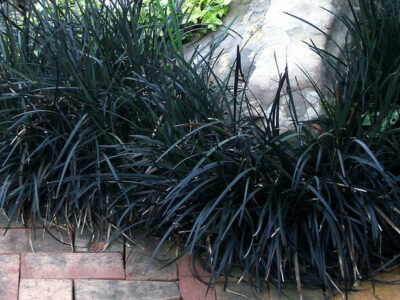
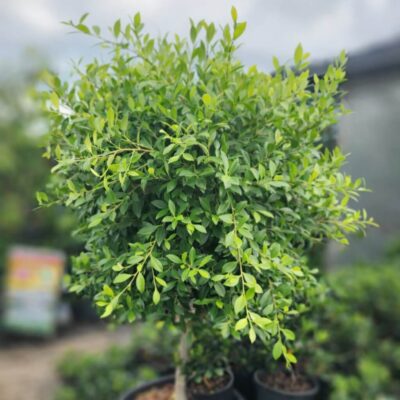
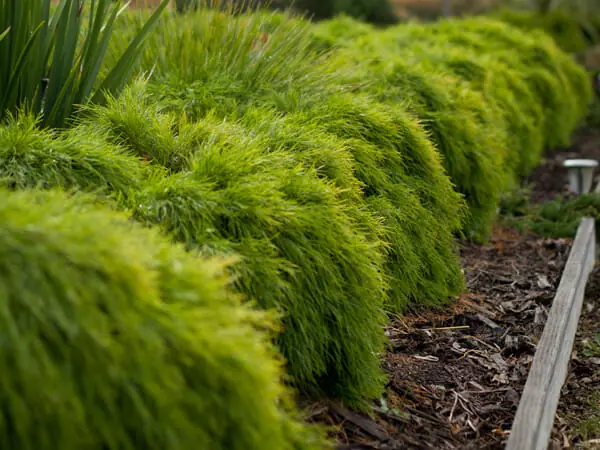
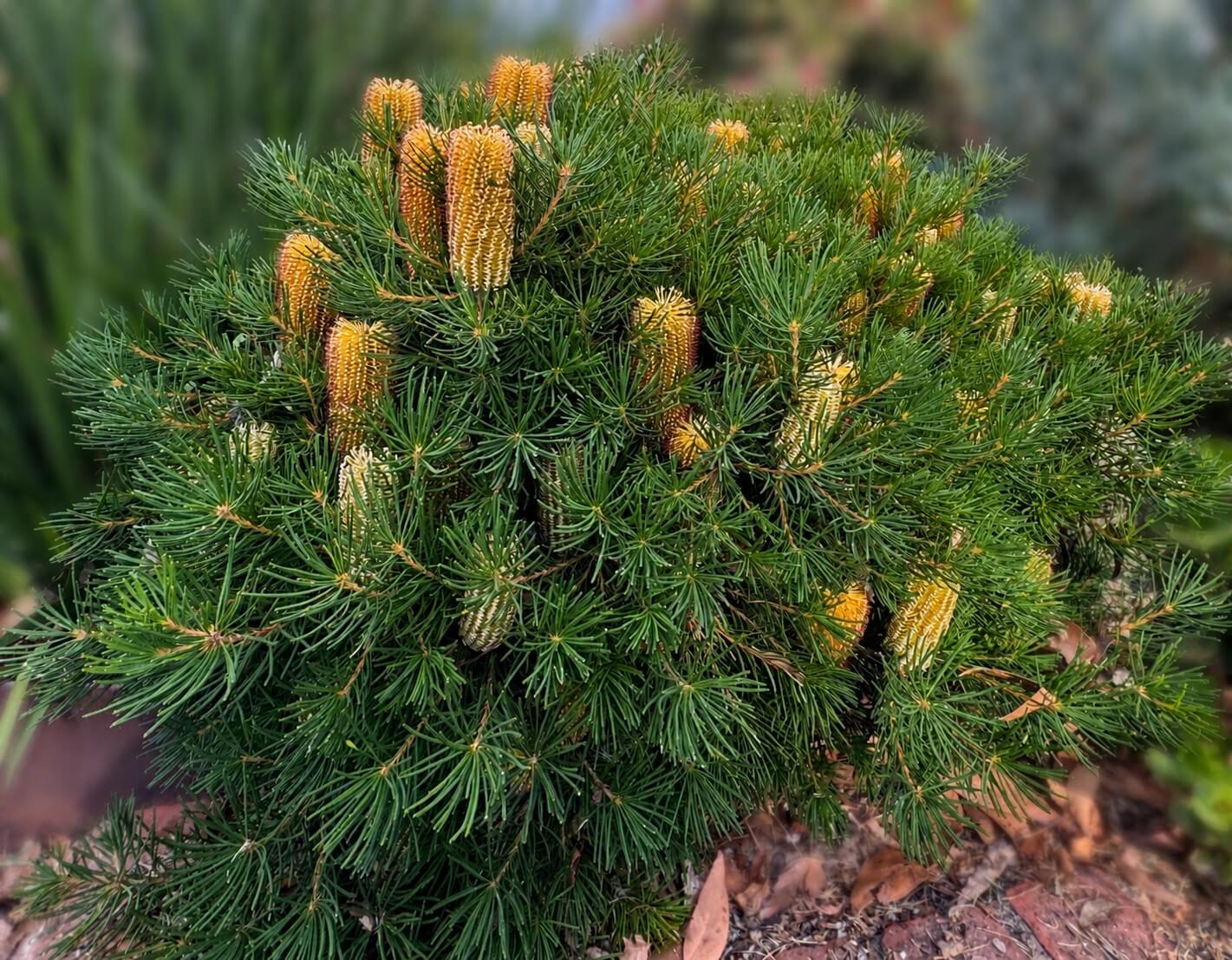
Hands down one of the most popular and best looking natives in our range. Loved for its naturally rounded shape, soft fine foliage and incredibly easy care growth habit.
Perfect for feature planting, borders, mass planting and modern landscapes, this stunning Australian native adds beautiful texture and colour year round.
Its soft green foliage is paired with subtle yellow pom-pom flowers and the best part? It’s naturally self shaping with very little maintenance required.
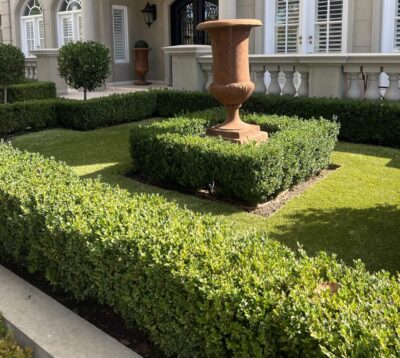
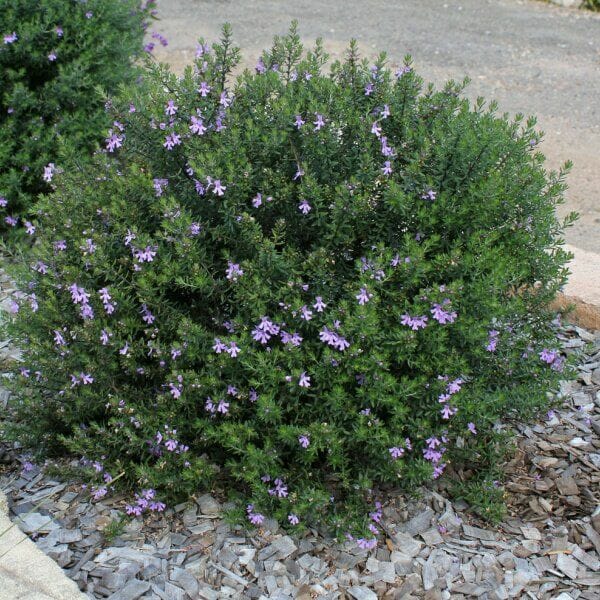
Westringia are known as Aussie Box and are one of the best native substitutes for traditional box hedging and topiary.
Their fine foliage grows quickly in a naturally compact shape while producing masses of delicate flowers in shades of pink, purple or white.
‘Jervis Gem’ is a dwarf growing variety loved for its neat form and very low maintenance nature, making it perfect for hedging, borders and formal native gardens.
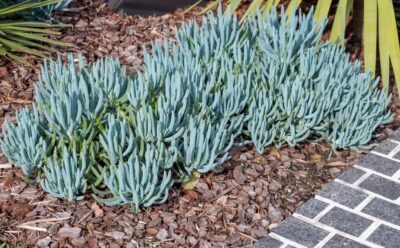
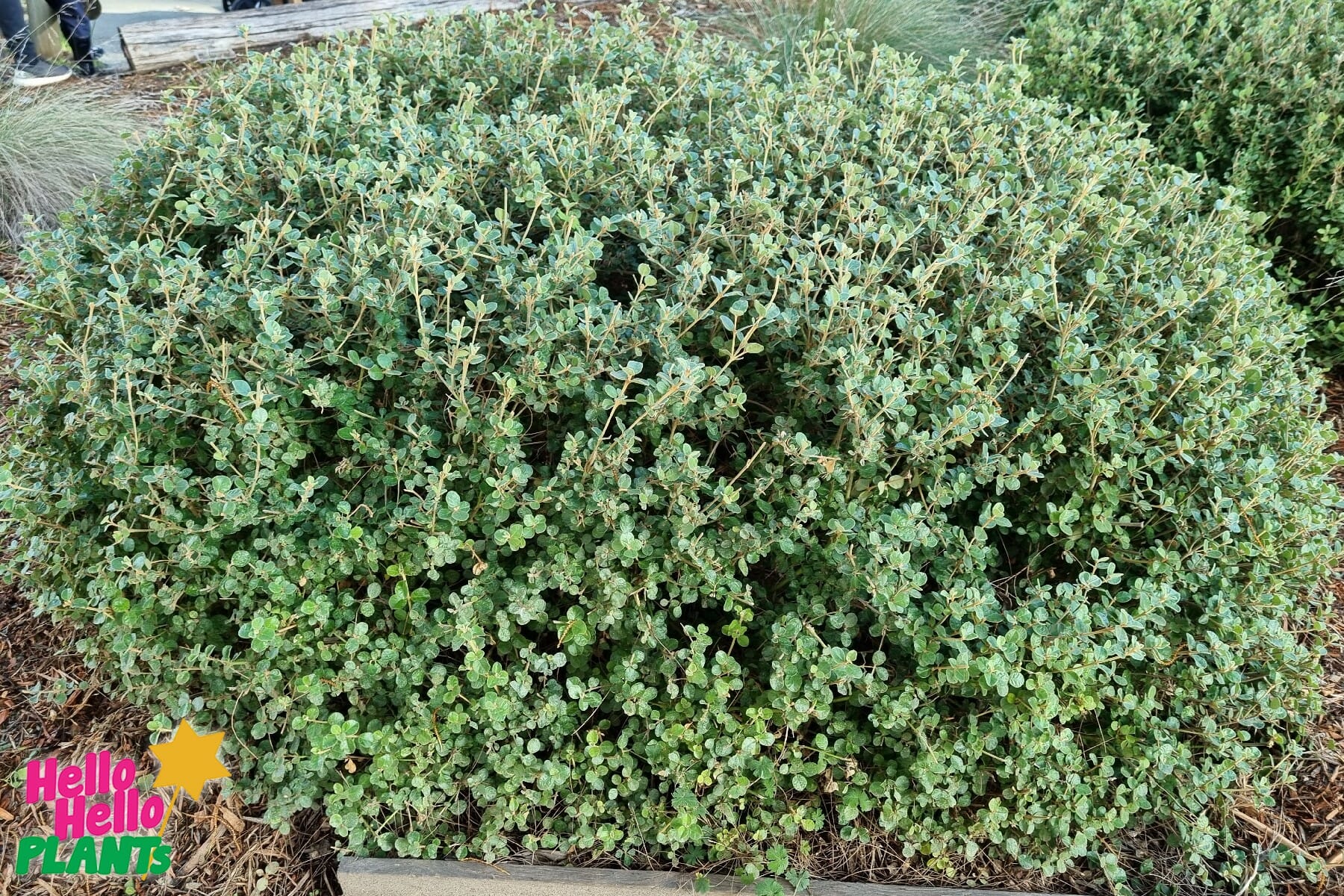
One of the cutest native groundcovers available, Grevillea ‘Mt Tamboritha’ is loved for its unique jelly-bean shaped foliage arranged in beautiful soft rosettes.
This low growing native spreads beautifully across garden beds, retaining walls and borders while producing masses of stunning strawberry cream coloured flowers.
Perfect for adding colour, texture and a soft cascading effect to Australian gardens, this hardy grevillea is both eye catching and easy to grow.
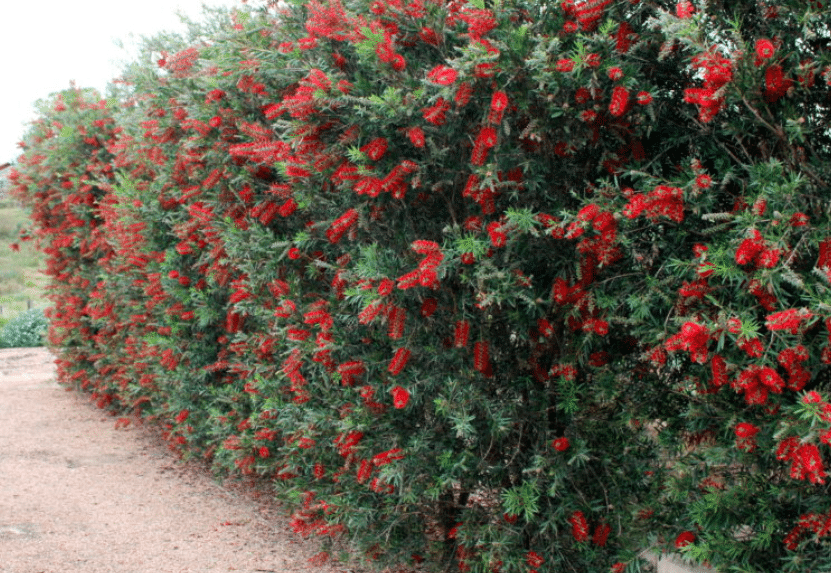
The problem with hedging is that you usually have to keep it constantly trimmed to maintain a neat shape. Not with this stunning native!
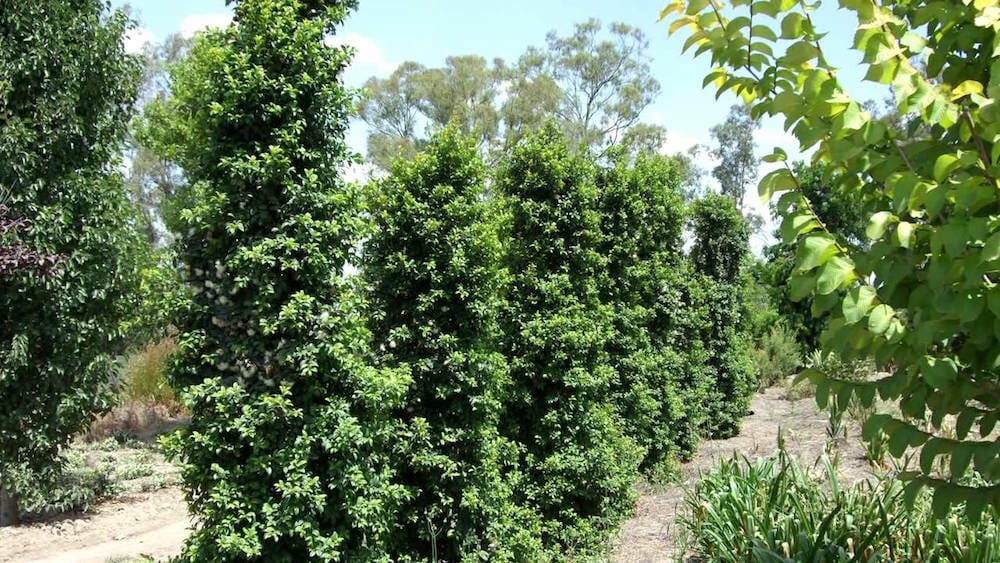
Callistemon ‘Slim’ is a special narrow growing variety that reaches only around 1 metre wide, making it an incredible option for hedging, screening and tight spaces.
Plus it produces masses of gorgeous bright red bottlebrush flowers for most of the year, bringing vibrant colour and wildlife into the garden.
One of the most eye-catching feature trees for the native garden, Eucalyptus ‘Silver Princess’ is loved for its elegant weeping habit and dramatic appearance.
Long white weeping branches, large drooping silver foliage and fluffy vibrant red flowers create a truly spectacular centrepiece in the landscape.
Perfect for adding colour, movement and architectural beauty, this stunning eucalyptus brings a unique Australian character to modern gardens.
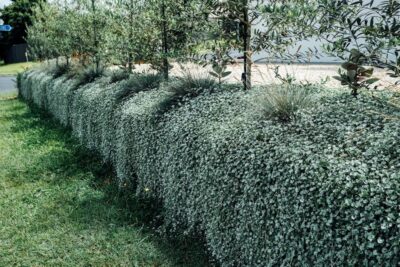
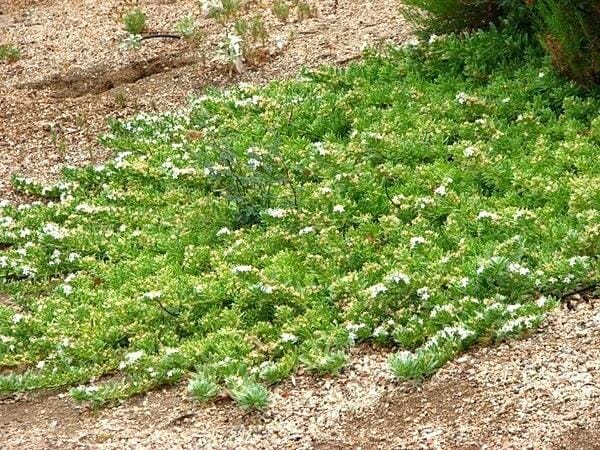
When it comes to hardy groundcovers, it’s hard to beat Myoporum ‘Fine Leaf’. This incredibly tough native grows low and dense, beautifully covering the ground.
Its thick spreading habit helps smother weeds naturally, making it an excellent low maintenance option for slopes, retaining walls and large garden spaces.
Finished with masses of tiny white star shaped flowers, this versatile Australian native brings softness, texture and practicality to the landscape.
A huge congratulations to 𝗡𝗮𝗲 𝗝𝗼𝘆 for winning our Garden Design Big Giveaway 🌿✨
We’ll be sending you a private message shortly, so please check your inbox.
Thank you once again — and congratulations on your amazing win!
A heartfelt thank you to everyone who participated and to our incredible community across Facebook and Instagram.
If you weren’t selected this time, don’t lose hope — perhaps next time the winner could be you. We believe luck is always on your side 💚
THIS GIVEAWAY HAS NOW CLOSED
Thank you to everyone who participated 🌿
Giveaway — Win a Garden Enhancement Package Worth $700+!
Does your garden need some serious love? Or do you know someone who’s been putting it off forever? This one’s for YOU (and them) 👇
That’s over $700 in garden goodness, up for grabs RIGHT NOW.
🎁 What You’ll Win
🌳 FREE Garden Design with Chris — a personalised plan created just for your space
🌸 Your choice of a stunning feature tree (valued at $200):
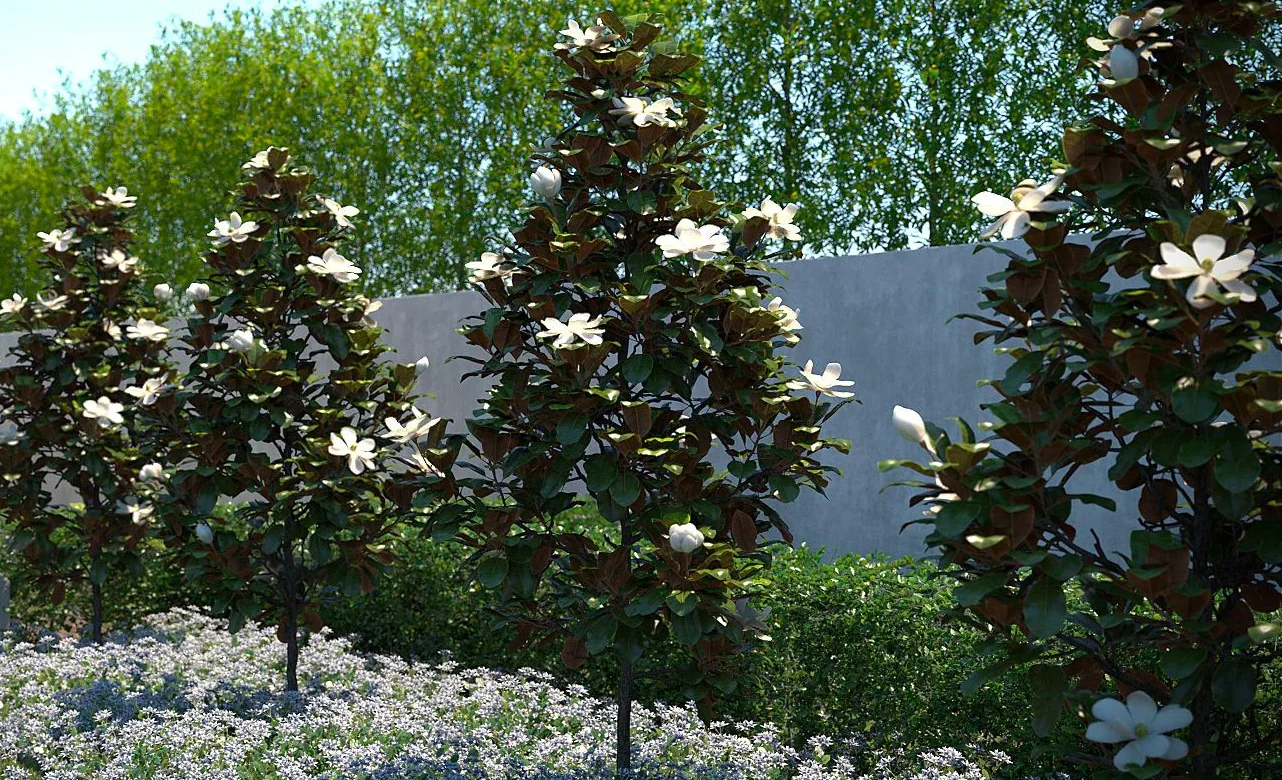
Sweet & Neat Evergreen Magnolia
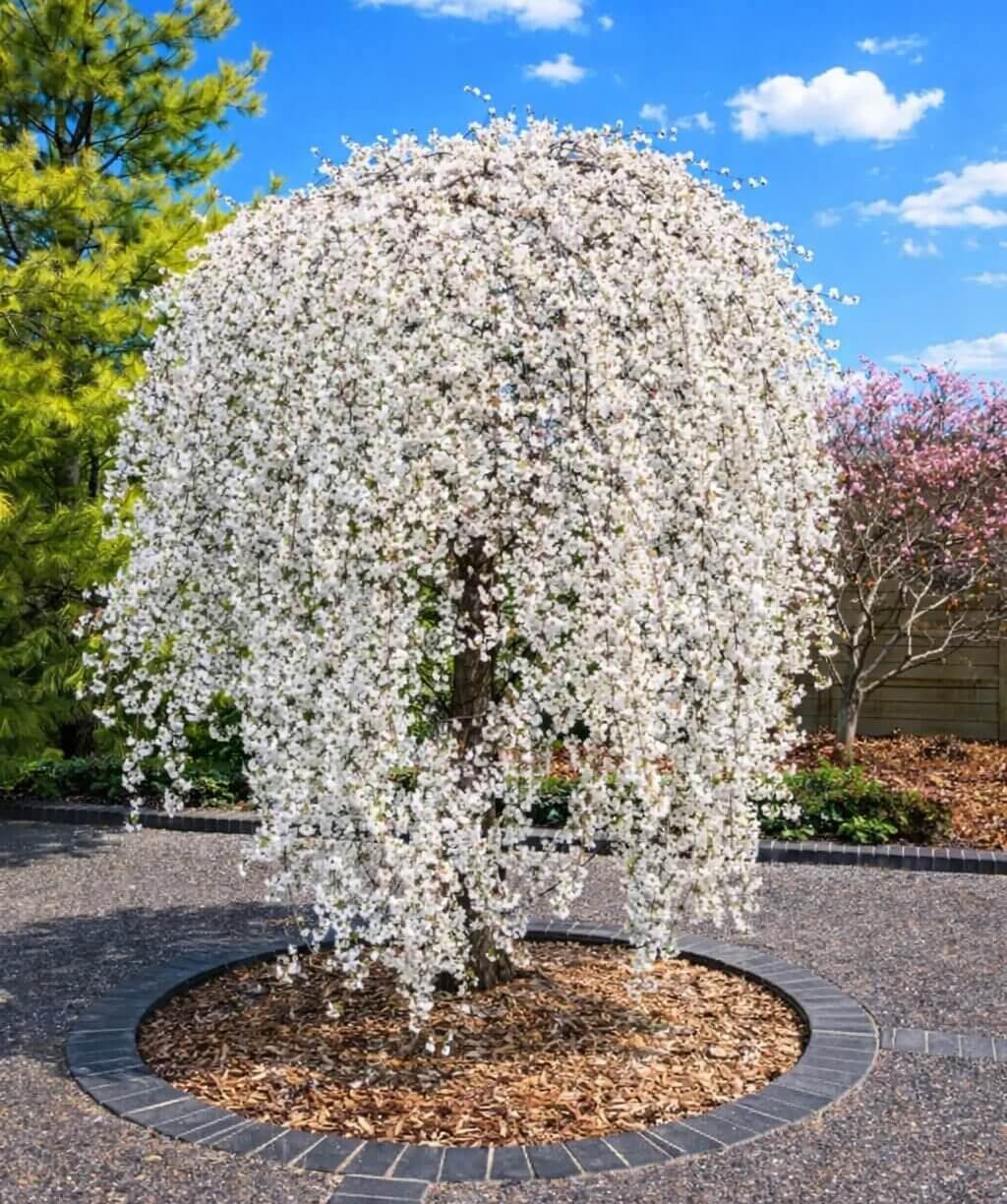
6ft Falling Snow Weeping Cherry
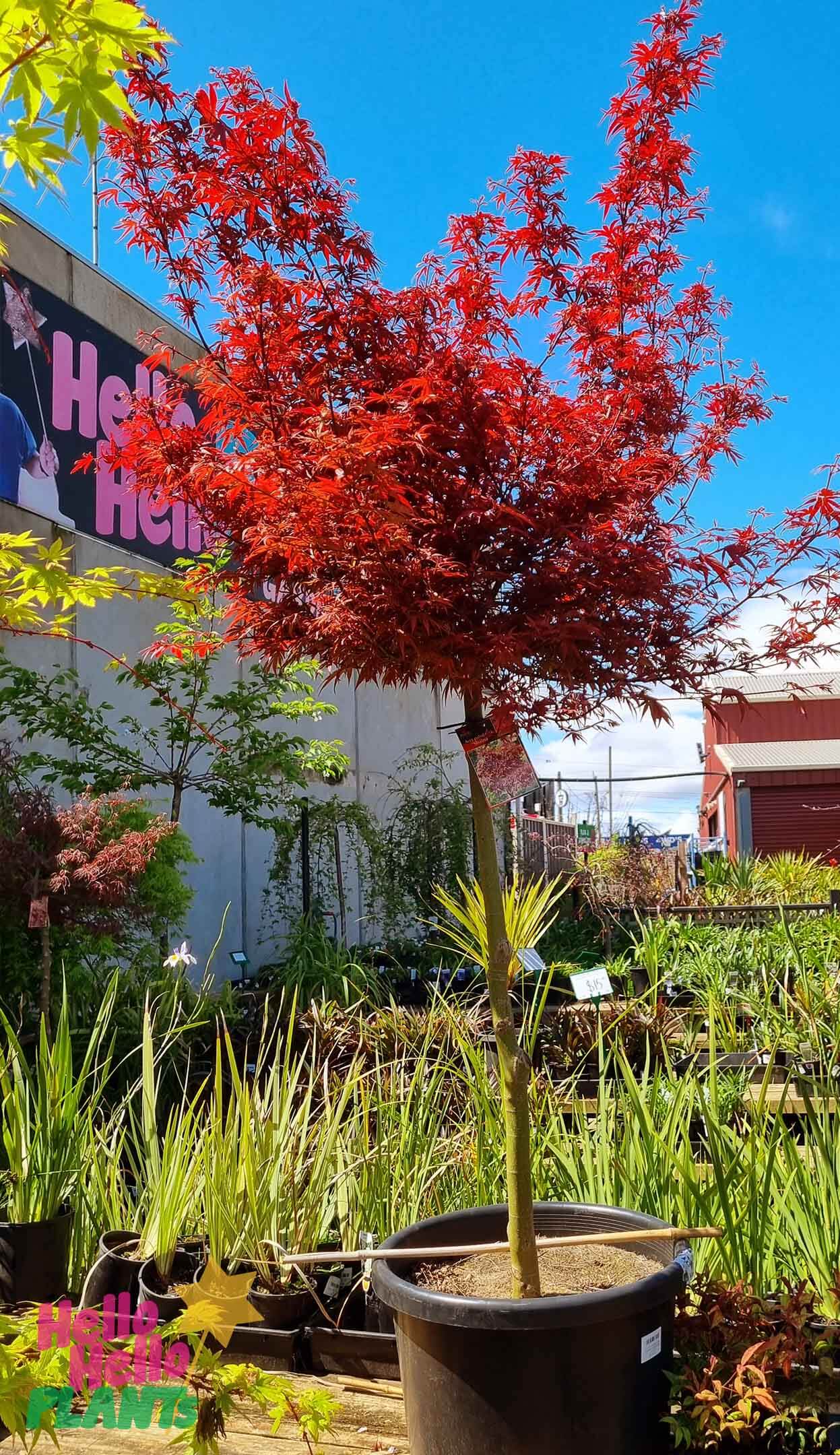
1.2m Grafted Red Leaf Shaina Maple
🌿 $500 worth of shrubs — you choose what you love
🚚 FREE delivery straight to your door
✨ How To Enter ✨
1
Tag 3 friends on our social media giveaway posts
2
Tell us WHY you’d love to win this garden design
3
LIKE The Post
f Enter on Facebook
At Hello Hello Plants, we believe your garden should feel like home.
A place to relax, connect, and enjoy every day.
Our free garden design service is built around you. Whether you are starting fresh or updating your space, our experienced team listens to your ideas and creates a design that suits your lifestyle and your garden.
This is not a generic plan. It is a one on one experience with a clear, personalised design you can confidently bring to life.
Most garden design services stop at the plan. We don’t. At Hello Hello Plants, we design your space and bring it to life with our professional landscaping team.
From concept to completion — one team, one vision, done right the first time.
The Weeping Evergreen Alder is a truly unique tree, a beautiful compact weeper with luscious, fine foliage all year round and a stunning cascading form that makes it a standout in any garden. Unlike most popular weeping trees like birch, cherry and maple, which lose their leaves in winter, the Weeping Evergreen Alder keeps its foliage year-round, giving you constant structure, softness and greenery. One of the best things about this tree is that it stays naturally small. Because the weeping form is grafted onto an upright rootstock and takes control of the growth, it will remain a compact feature tree for decades.
It’s also incredibly tough, wind hardy and able to handle boggy and poor soils, making it perfect for those difficult spots where other weeping trees might struggle or even fail. Whether used as a feature centerpiece or planted in evenly spaced rows for a formal evergreen look, it’s a versatile, low-maintenance option that delivers a really elegant result.
The Weeping Evergreen Alder
The Weeping Evergreen Alder is created by grafting a weeping form onto an upright seedling,
which gives it that beautiful structured shape while maintaining its graceful cascading habit.
It was actually very popular back in the ’90s, but when the nursery growing them changed hands,
production stopped, mainly because it’s a difficult tree to grow and produce, and they’ve been unavailable for many years.
That’s where Chris comes in.
After finding some beautiful specimens locally, Chris spent the last three years working with one of Australia’s
leading tree grafting nurseries to bring them back into production.
And now, they’re finally available again at Hello Hello Plants.
The good news is, while they’re difficult to produce, they’re actually very easy to establish, grow and maintain once planted in your garden.
Alnus ‘Evergreen Alder’
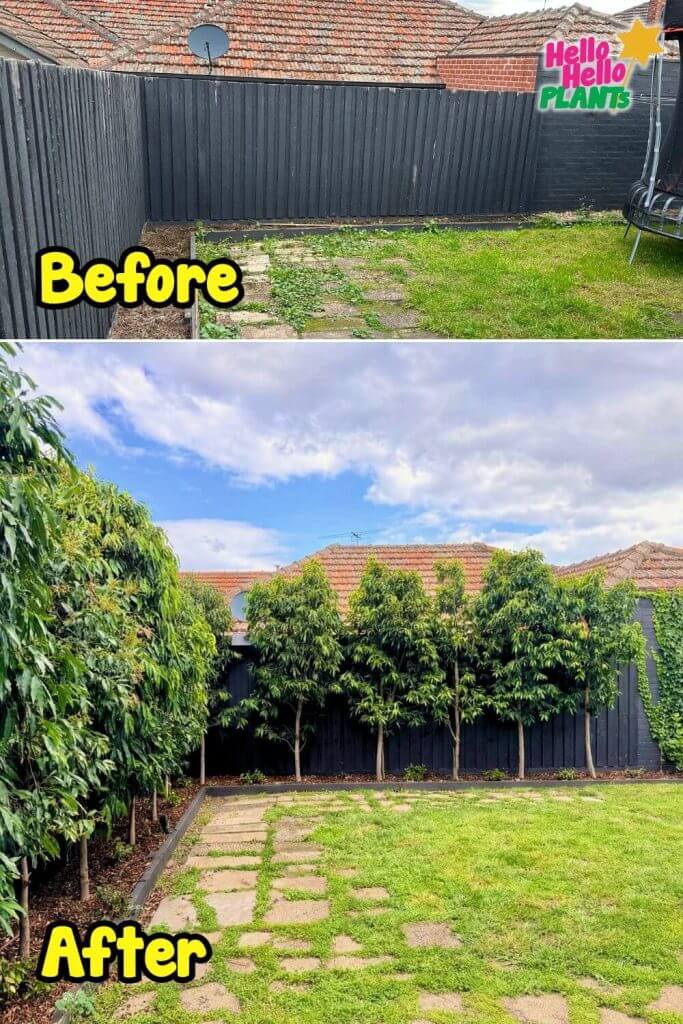
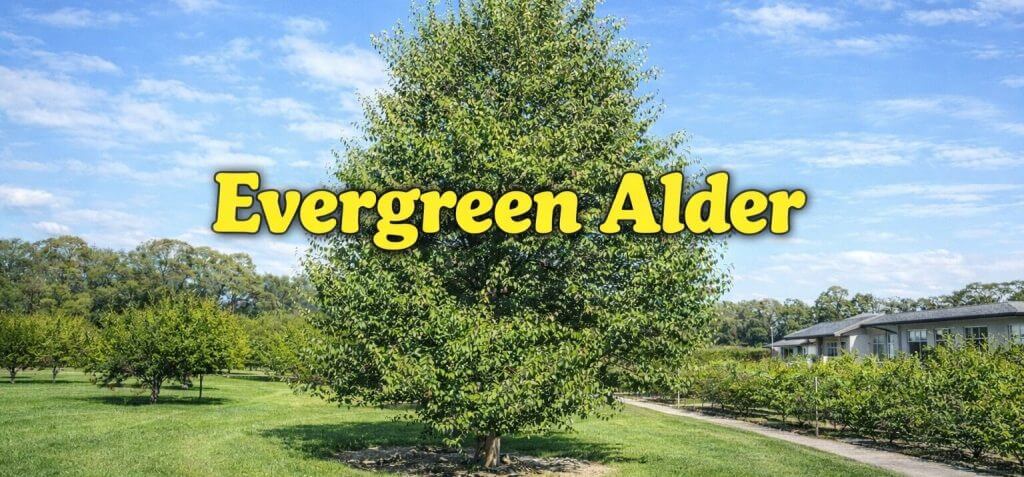
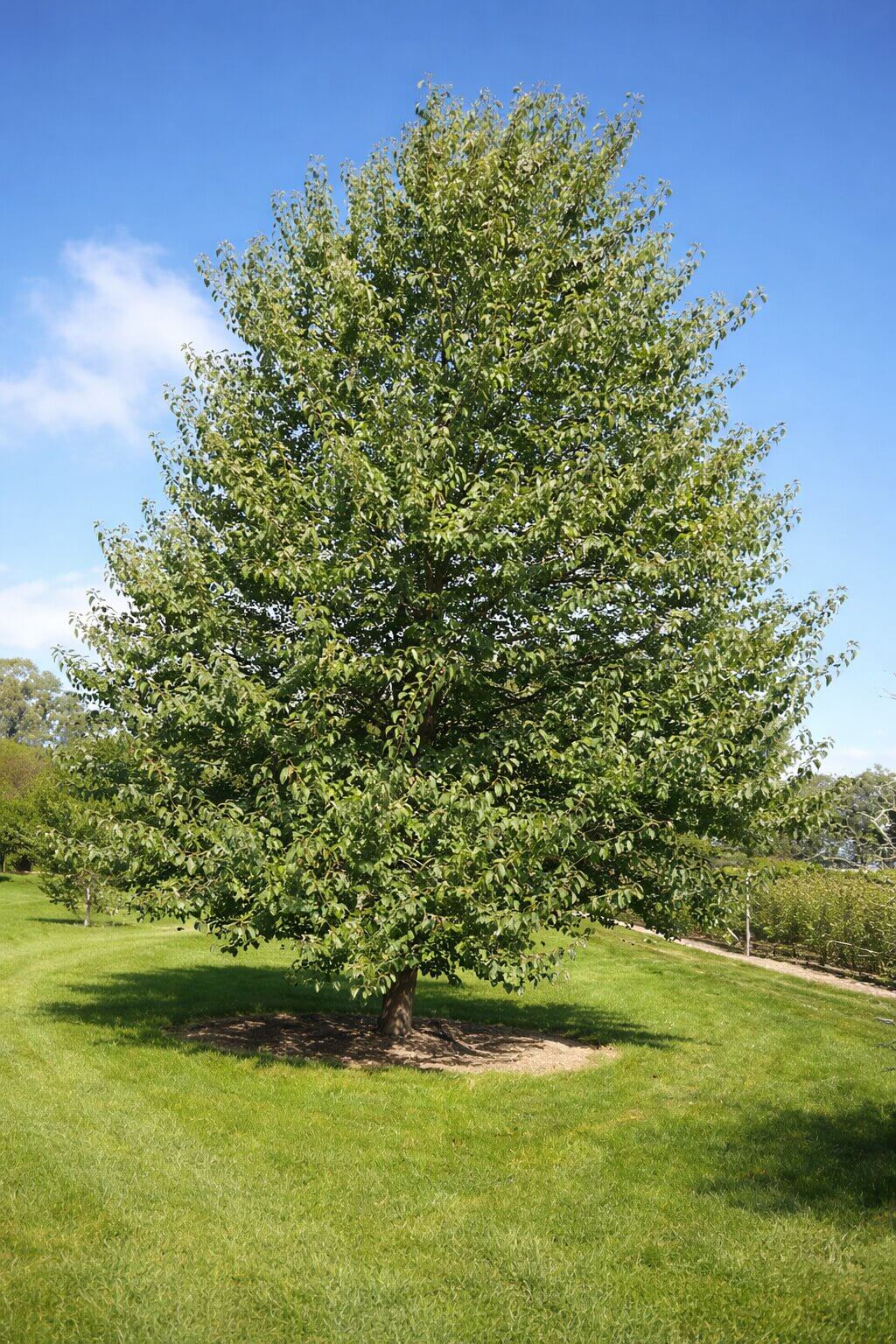
The Evergreen Alder (Alnus jorullensis) is an incredibly fast-growing evergreen tree that delivers rapid impact and real function in the landscape. With soft, fine foliage and a slightly pendulous form similar to a silver birch, it creates a light, elegant look while still being tough and practical. One of its biggest advantages is just how fast it grows, with good conditions, plenty of water and a bit of fertiliser, you can take it from an 8-inch pot to a stunning 5-metre tree in as little as a year. It’s also a problem-solver tree. The Evergreen Alder thrives in heavy, wet soils, subsoil conditions, and even areas that flood occasionally, making it ideal for spots where many other trees simply won’t perform. Another standout feature is that it’s a nitrogen-fixing tree, one of the few that actually improves the soil around it. This means lawns, gardens, orchards and veggie patches nearby can all benefit, as it acts as a natural nurse tree, enriching the soil and supporting surrounding plant growth. On top of that, it’s wind hardy and extremely versatile, perfect as a feature tree, screening plant, avenue planting or shelter belt.
🌿 Did You Know?
Evergreen Alder is Ideal for
Screening & Pleaching
This isn’t just a feature tree — it’s one of the most effective natural screening solutions for modern gardens.
Year-round privacy with dense evergreen foliage
Perfect for pleaching & structured hedging
Fast growing for quicker full coverage
Creates a clean, architectural statement
SHOP
Standard Evergreen Alder Trees — Feature Trees & Structured Hedging
Evergreen Alder Advantage
Because of its vigorous growth, the Evergreen Alder does develop a
strong, active root system, which is part of what makes it so effective in tough conditions.
For that reason, it’s best planted in areas where it has room to grow and do its job,
away from structures, pipes or anything sensitive to root activity.
Give it the right placement, and it will reward you with
fast growth, improved soil, and a
powerful presence in the landscape.
Visit Us In Store
Come and see our Evergreen Alder trees in person at our nursery.
1477 Sydney Rd
Campbellfield VIC 3061
Free Delivery Offer
Order online and enjoy convenient delivery straight to your door.
Spend over $399
FREE DELIVERY
Delivery Information
View delivery areas, pricing and conditions before ordering.
When we think of Autumn, the first thing that comes to mind is the magical transition of lush greenery to hues of red, purple and gold, which eventually drop from the tree and cover the ground like a mosaic carpet. This creates an atmosphere of warm, vibrant impressionistic colours that we all love. And it only lasts for a couple of months before it vanishes into the cold depths of winter.
Why do the leaves of trees change colour during autumn?
As autumn approaches, trees begin to break down the green chlorophyll in their leaves into nutrients and then they redistribute these nutrients to their trunk and roots to store over winter. This keeps them going throughout the winter when sunlight is sparse.
The yellow colour seen in some autumn trees results from the loss of chlorophyll simply unmasking the yellow that was there all along. But red colouration comes from a pigment called anthocyanin, which has to be made afresh as autumn takes hold. Click here to read more about the science behind leaf colour.
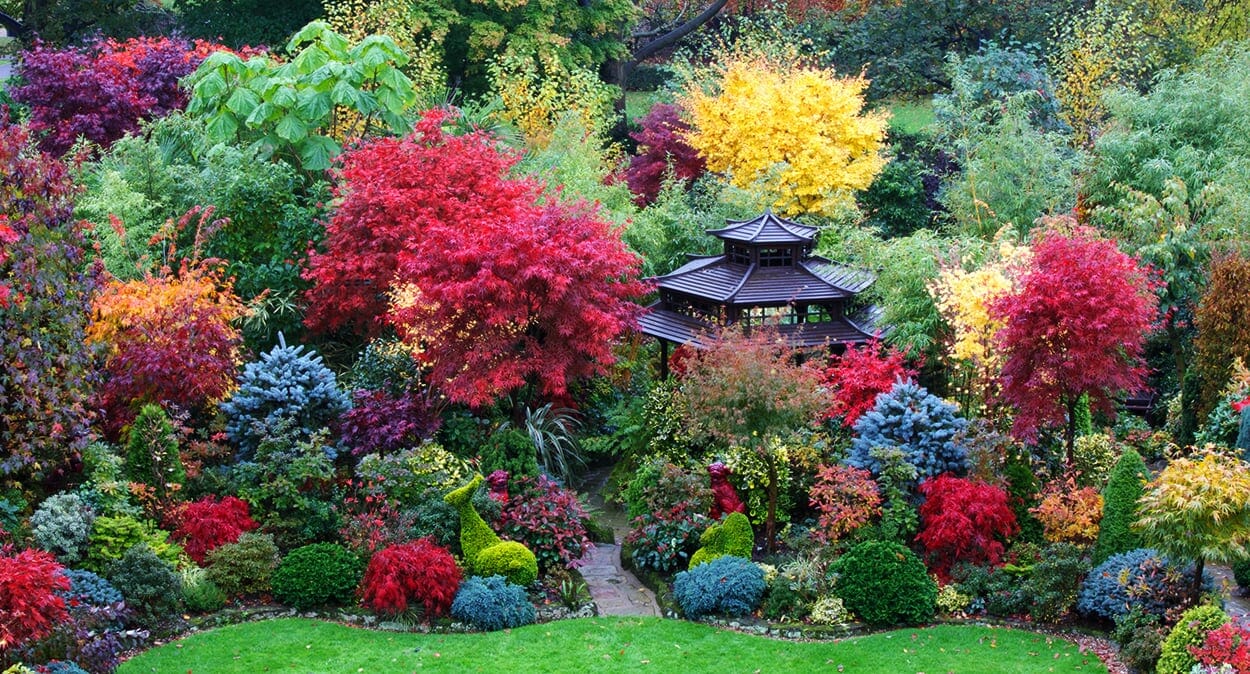
Four seasons gardens, UK
Here are the top 10 most beautiful autumn Foliage Trees.
1. Acer Palmatum ‘Senkaki/Coral Bark’ Japanese Maple
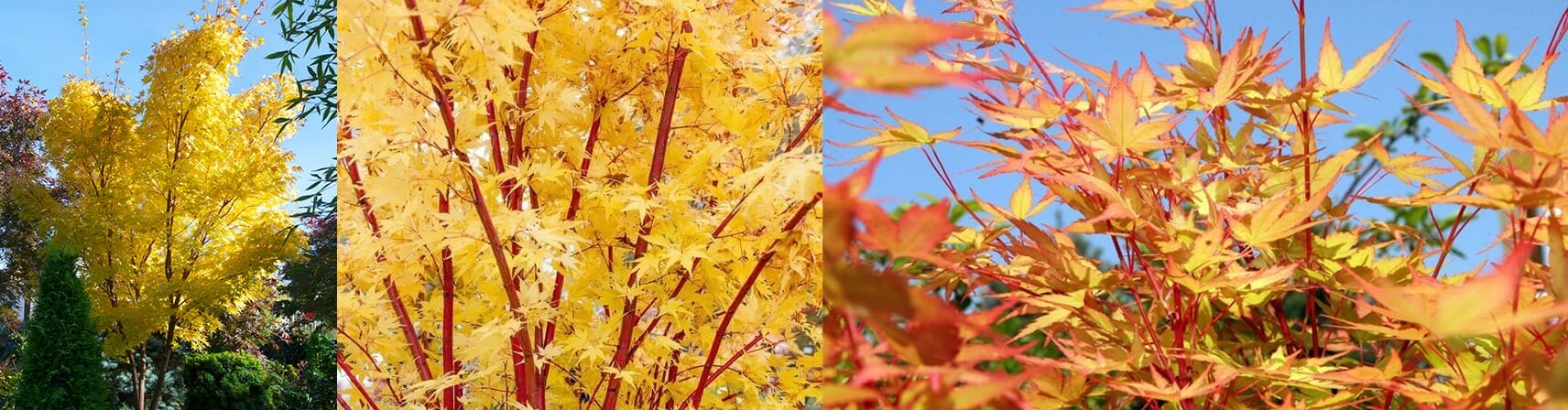
Also known as Sango-kaku, or Coral Bark Maple, you simply can’t miss the Senkaki Maple with its distinctive coral-red bark, which contrasts with its bright green leaves in spring and summer. Autumn sees the foliage turn gold and eventually, winter leaves you with a beautiful bare sculpture of a tree with striking red bark. One of the beauty queens of all deciduous trees. It forms a beautiful vase-shaped tree that grows to approximately 5m high and 4m wide.
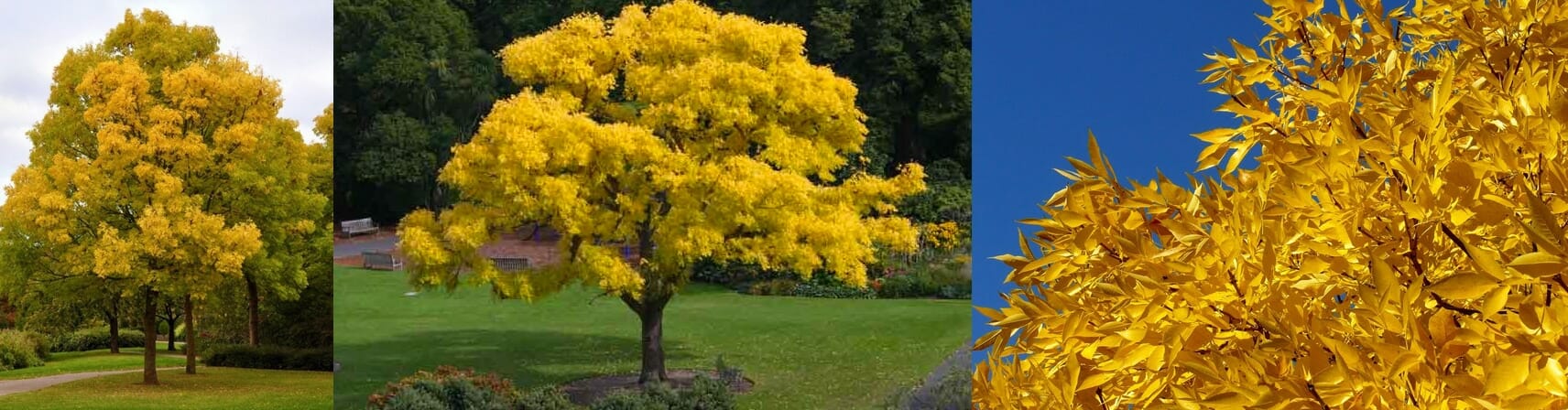
Ash trees are gorgeous feature trees with soft foliage and brilliant autumn colour. These two varieties produce the best show in autumn. Golden Ash has iridescent yellow foliage in the autumn, a change from its regular lime green summer leaves. During the winter months this tree still makes a statement as its bark reflects the same yellow as its fallen leaves! A stunning tree with multi-seasonal interest. It grows to about 8m x 5m.
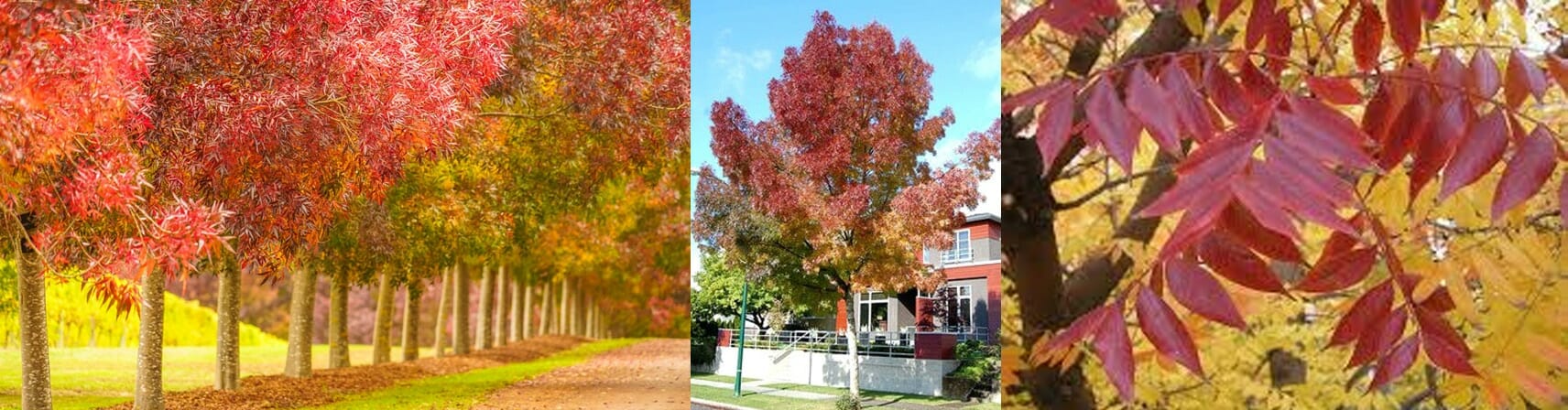
An attractive, some say fast-growing deciduous tree with an upright growth habit and open canopy. The foliage is deep green and narrow in summer and as autumn approaches, turns a rich claret colour, hence the name. This is a beautiful tree with stunning autumn colours, tolerant of frost and drought. Mature height up to 12m high x 7m wide.
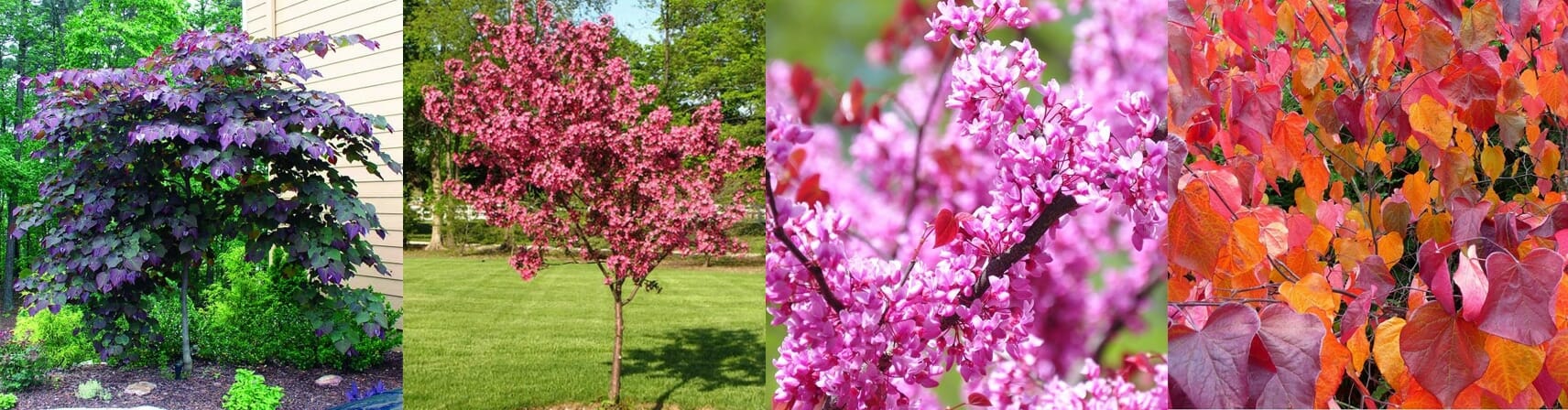
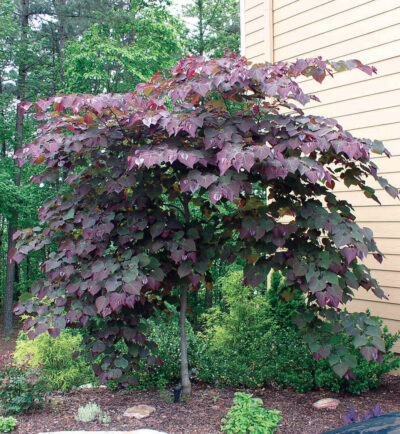
The Forest Pansy is an incredibly beautiful small growing deciduous tree with colourful heart-shaped foliage. It is noted for its gorgeous rose-purple flowers which bloom profusely on bare branches in early spring before the foliage emerges, first red in spring, then deep purple-tinged green in summer, then turning all shades of yellow, red, purple and orange in autumn.
This tree requires low maintenance and is perfect for small gardens and courtyards. Should be planted in either full sunlight or partial shade and in well-drained soil.
The Ginkgo or Maidenhair Tree is remarkably known as a ‘living fossil’, as it is the sole survivor of an ancient group of trees that date back beyond the time of the dinosaurs. It is a perfect specimen or feature tree due to its long life and showy light green leaves, which have a unique shape. These leaves light up the landscape in autumn, turning a glowing yellow.
The Maidenhair Tree remains virtually unchanged today and represents the only living bridge between ‘higher’ and ‘lower’ plants (between ferns and conifers). Maidenhair trees can be extremely long-lived, the oldest recorded individual being 3,500 years old.
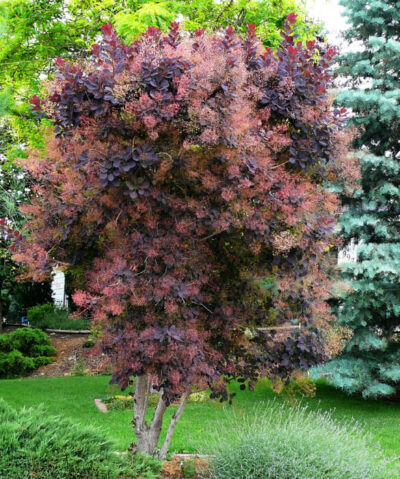
Smoke Bush is a gem in the garden thanks to its unique blend of colours that change throughout the seasons. A large deciduous shrub or small tree, its beautiful eye-catching spring foliage is green overlaid with purple. Summer brings deep purple foliage that then turns deep orange and bronze in a burst of glory for an autumn show. Special smoke bush varieties offer variations of this beautiful shifting colour scheme.
Smoke Bush gets its name from the clouds of smoke-like purple and pink “flowers” it produces in early summer. These are very beautiful themselves and are prized along with the foliage by florists. Grows best in full sun to partial shade and it is tolerant of drought and most soils, making it a great addition to many gardens.
It is available in 4 different varieties which have slightly different colours.
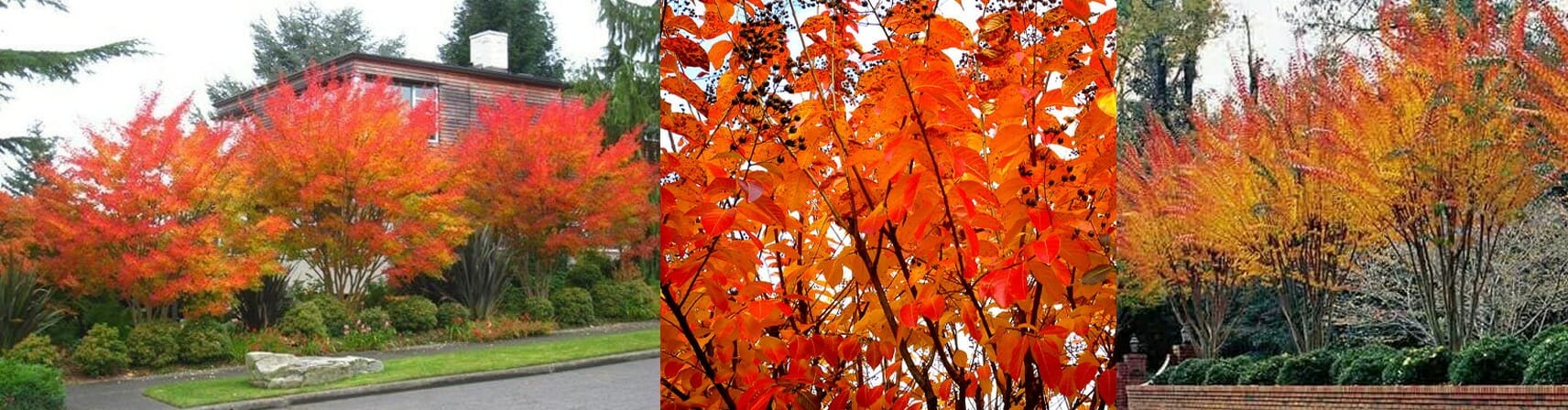
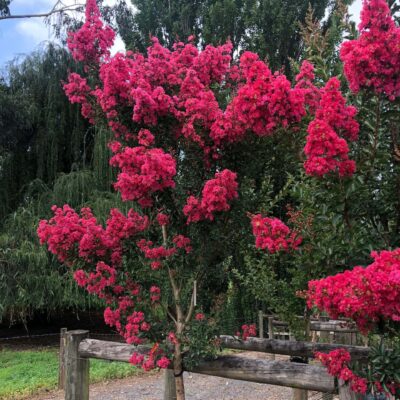
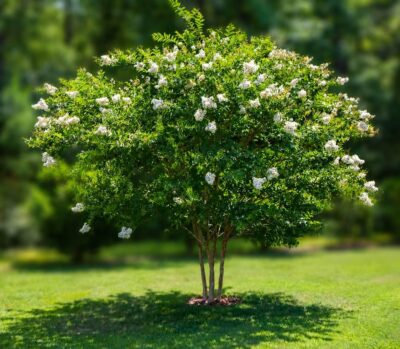
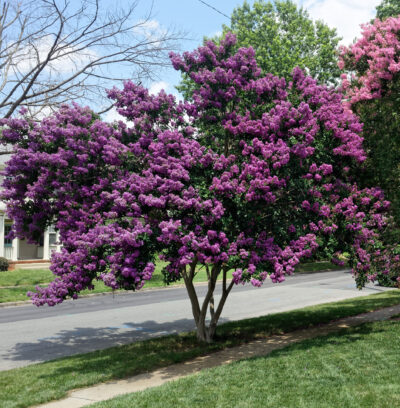
Crepe Myrtles are simply the world’s best summer-flowering trees. Intense flower colour, a long flowering season, good autumn colour, handsome bark and attractive spring foliage mean they are enjoyed in all seasons. They are deciduous trees or small shrubs that range in size from around 3-8m fully grown. Crepe Myrtle’s are popular due to their beautiful crepe-paper textured flowers, and the fact that they remain relatively small as a tree in most conditions. Their autumn foliage is fluorescent and can be seen from miles away!
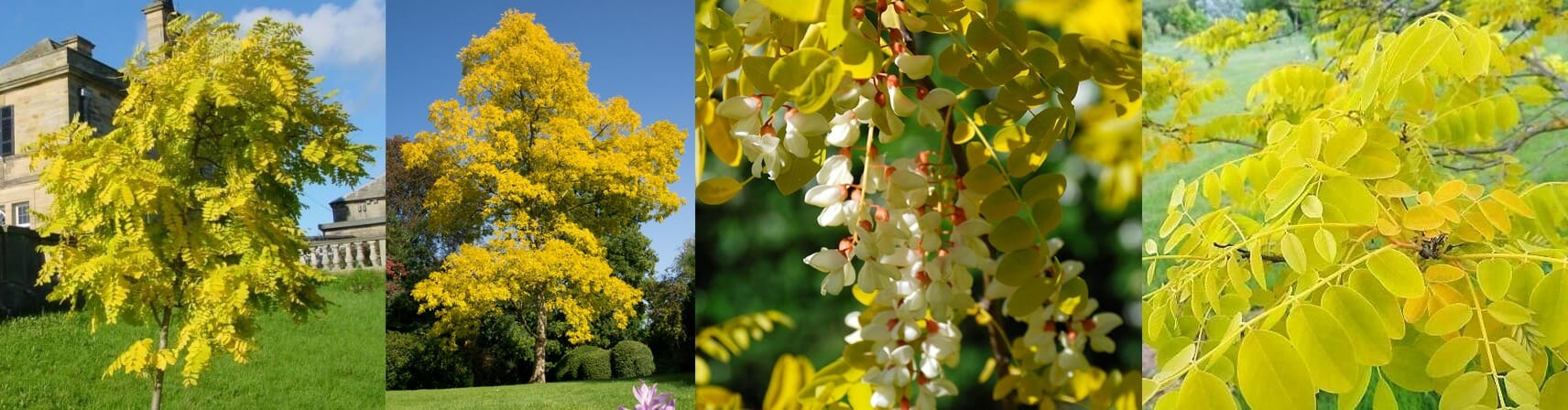
Golden Robinia has beautiful yellow spring leaves which deepen in colour to a fresh lime-yellow during summer, then turn golden-yellow in autumn, before falling.
A visual standout amongst other trees, this Robinia tree is an all-round tough plant suitable for many different landscape uses. Whether as a magnificent specimen or a street tree in polluted and industrial areas, it grows with vigour and strength.
The Tulip Tree is a beautiful tall tree with large leaves that have a lovely unique shape and smooth soft texture. A fast-growing deciduous hardwood tree, Tulip Trees have striking yellow-green orange flecked coloured flowers. They are solitary flowers that sit in the extreme-most upper branches. The flowers resemble tulips, hence the name. In the autumn the leaves turn a brilliant yellow before falling. The leaves make a wonderful rustling sound during the warmer months in the cool breezes. For an avenue, we recommend planting these trees 7m apart or for a screen 3m apart.
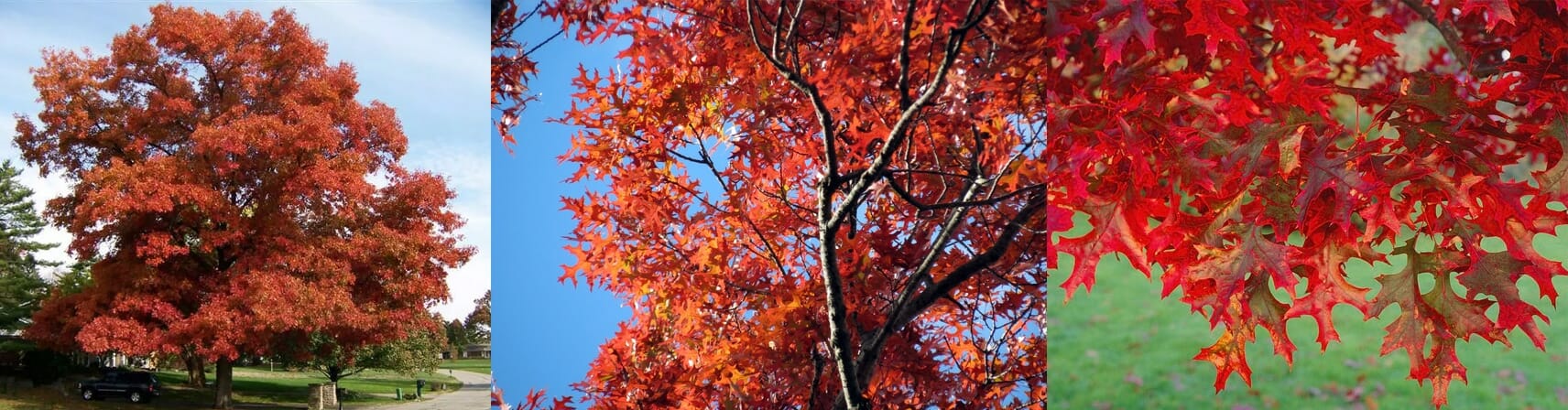
This lovely sturdy Oak is popular due to its spectacular autumn display, when the dark green foliage turns to shades of orange, bronze and brilliant red, displaying more intense colour the colder the environment. It holds its foliage, sometimes into early winter, and in spring will produce acorns when the tree is mature. It is similar to the Red Oak and Pin Oak, but generally preferred for its more brilliant autumn display. Growing up to 12 metres, it would be best suited to a large garden and would look stunning as an avenue planting. It requires a position in full sun to part shade and is fairly adaptable to its surrounding environment.
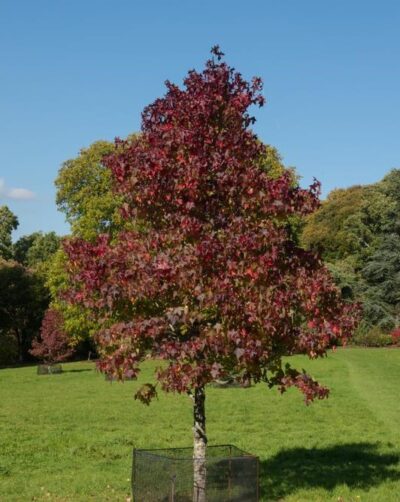
The Sweetgum is a well known, tough and attractive deciduous tree that is a good choice as a specimen for larger gardens and in park plantings. Sweetgum is renowned as a source of strong, extended autumn colour and makes excellent shade trees, where space permits.
There is a slightly different cultivar called the Liquidambar ‘Burgundy’ Sweetgum which resembles the species very closely but is distinguished by its exceptional purple-red to autumnal colour and by leaves that remain longer on the tree in the autumn
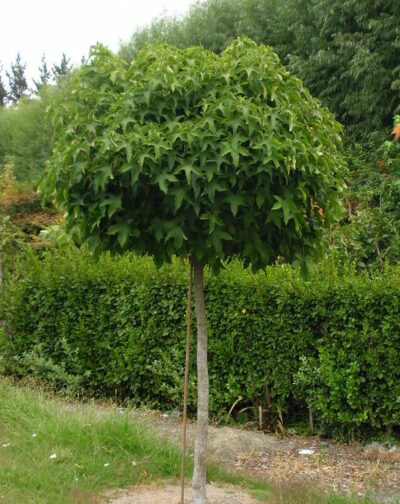
Another smaller option would be the grafted Liquidambar Gumball, which is a standard form that grows to around 2m tall.
Here are a few more superb Autumn foliage trees that have little extra features that make them very attractive and popular.
Acer freemanii ‘Jeffers Red Maple’
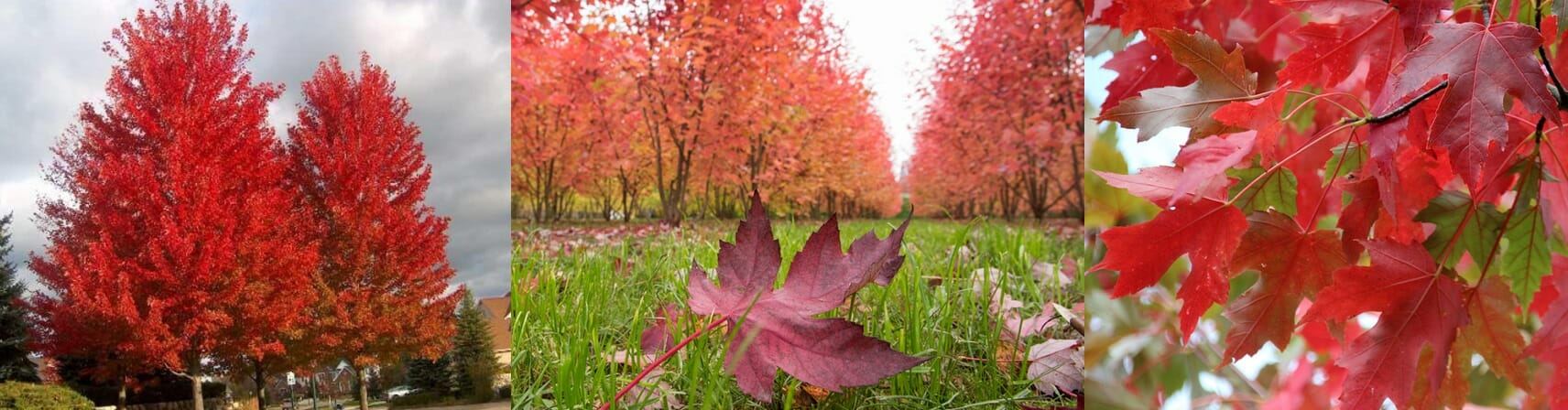
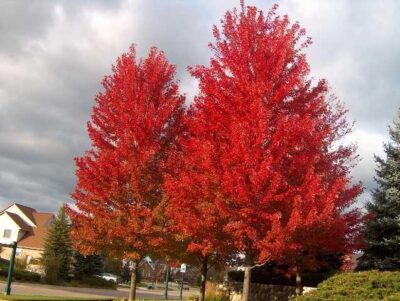
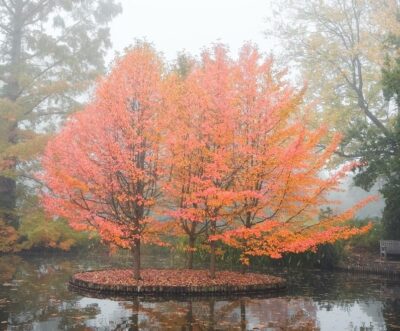
The Jeffers Red Maple is a gorgeous maple that hosts some of the best autumn colours around, with a blend of yellow, orange, copper, rust and vivid reds gracing its branches. It has a lovely compact shape and a single straight trunk that looks as if it has been pleached naturally (bare lower trunk). With a medium rate of growth, this tree will grow to 8m, is not too particular about the soil quality, is mildly drought tolerant and tolerates frost. Fantastic for a feature tree, in parks, on industrial sites or in avenue plantings, this tree is sure to please.
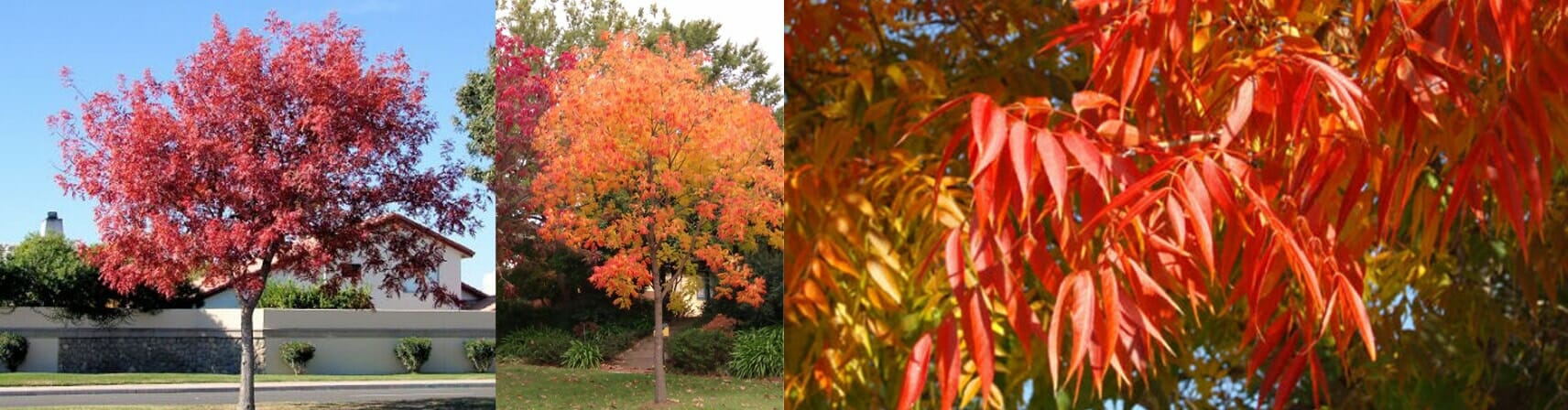
The Chinese Pistachio is a tree that offers the ideal combination of aesthetics and versatility for a wide range of landscapes. It bears fine foliage in a wide range of Autumn colours including bright yellow-orange, crimson or scarlet, and rich green in Summer.
Prefers to be placed in a position of full sunlight but can cope with partial shade. This tree grows fast in suitable conditions, and will not grow above 8 metres tall. Once established it is very hardy.
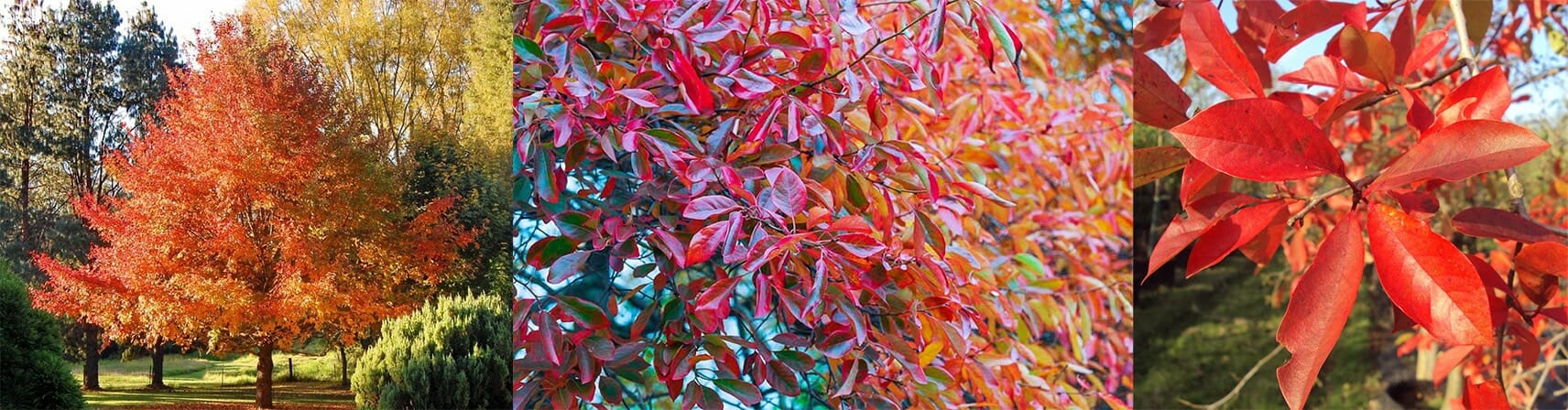
The Tupelo Tree is a beautiful deciduous specimen tree with a pyramidal shape. A magnificent tree in autumn when the leaves turn orange to scarlet. Likes moist, moderately fertile, well-drained soil in full sun and tolerates wet conditions well. Also called the Black Tulepo, it has a fast growth habit and is a spectacular feature tree. Grows to about 12m high x 6m wide.
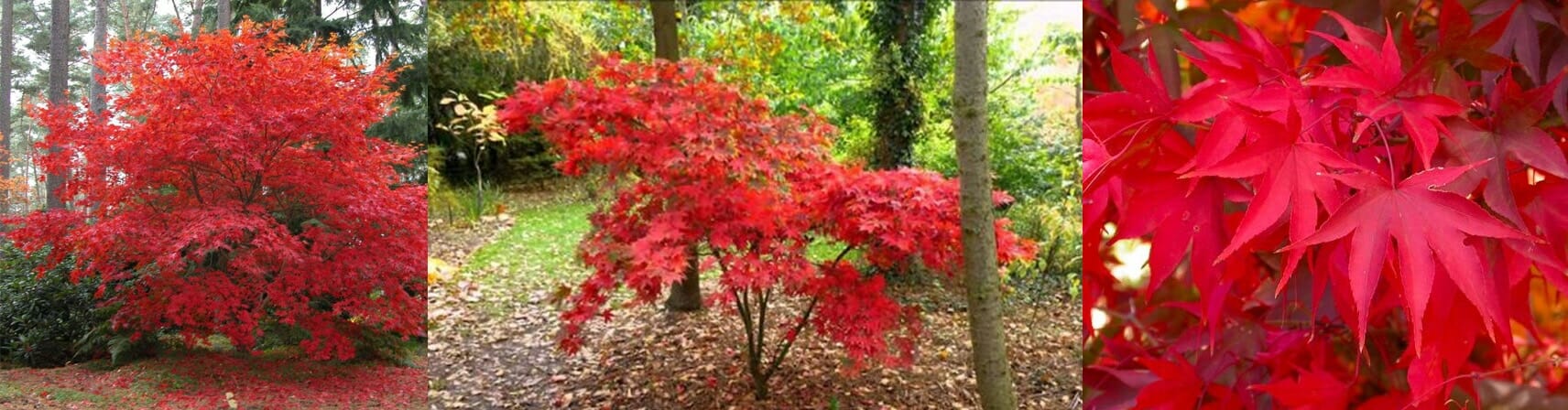
The Osakazuki Maple is a large bushy deciduous shrub or small tree, whose foliage is green but turns to a brilliant orange-scarlet in autumn.
An Osakazuki is best placed in a position of partial or full sunlight and moist but well-drained soils. Grows to a height of 2-4 meters. This shrub requires low maintenance once established. Ideal as a focal point of the garden.
Chinese Tallow Tree has rapid growth, precocious and prolific seeding, adaptability to a wide variety of soil conditions, tolerance of both drought and frost. This deciduous tree has an upright habit and is long-lived. Slender flowers are displayed in spring. This attractive small tree displays round or oval sharply pointed foliage; that turn red in autumn.
Also known as Persian Ironwood, Perssian Witchhazel is a slow growing, small deciduous tree. It features deep green glossy leaves with uneven shallowly scalloped edges, colouring to beautiful gold and crimson tints in autumn, and an open vase-shaped head on a short trunk. Suitable only for cooler areas in any reasonable soil with good drainage. Withstands dry conditions and exposure to wind once established.
Gleditsia Ruby Lace trees are proven as hardy street and shade trees, being fast-growing, heat and drought tolerant. They are well-suited for the demands of urban environments. The trees grow with an open, spreading canopy and have attractive, elegant, somewhat weeping foliage.
The ‘Ruby Lace’ variety grows to a small to a medium-sized tree and is distinctive for its shiny foliage that emerges as ruby-red, turning bronzy-green and then to a beautiful yellow-gold in autumn.
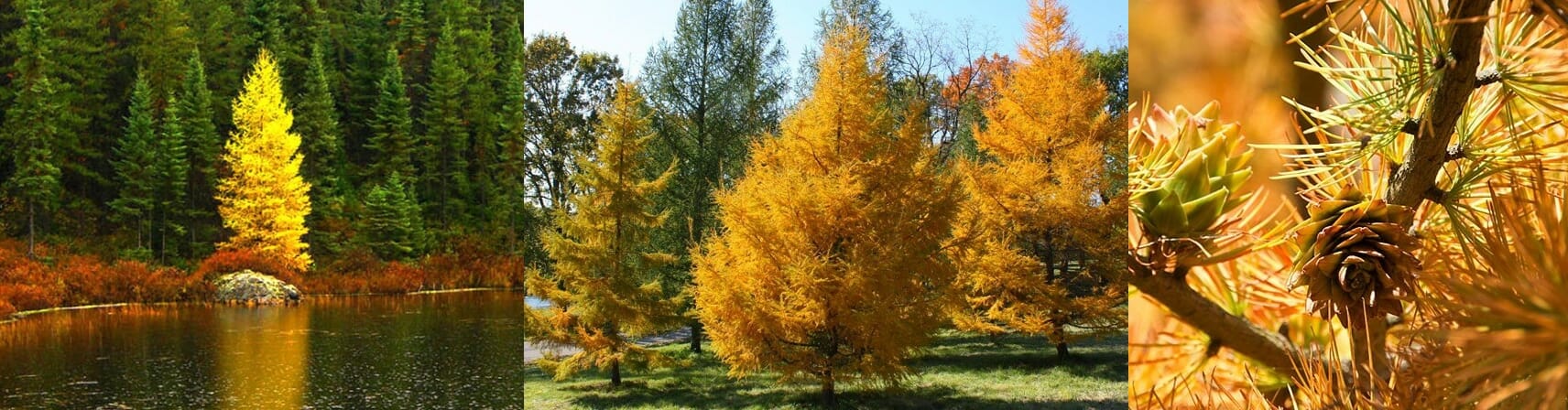
A cone-shaped tree with soft green needle-like foliage, the Golden Larch is a unique tree in that it is one of the only deciduous conifers (pines etc) in the world. During autumn, the needles turn a golden yellow. It produces deep purple cone-shaped fruit in summer. Plant in well-drained soil.
That’s it for this list. Keep an eye out for our next exciting list: Top 10 Autumn Shrubs.
Check out some other articles that you may like:
Sign up for our newsletter below
We will send you gardening tips, great deals, and exclusive giveaways. Happy Gardening!
I expect this spring will be the biggest spring in many years on the real estate market because already lots of people are buying & selling. Interest rates are falling and house prices have risen every month for the last five months, and they are expected to rise strongly with the next two expected interest rate falls.
Head straight to each section of how to increase the value of your property:
One of the ways to maximise your value in a rising market will be to have the garden looking great when people pull up at the front of your place!
Here’s some ideas about how to get your garden looking great.
One of the great ways to deck your garden out with great plants is to shop all the incredible sale prices for plants in our Growers Direct Flash Sale! We have lots and lots of really great specials.
You can also get a Free Garden Design with us. You just pay a small deposit, and then when you buy your plants that deposit comes off your price so you get it back. This could be just what you need to get your house looking great to go on the market in springtime.
https://www.youtube.com/watch?v=RHH6WVaiqYE
The other thing we recommend is to work out what date you’re going to go on the market and then start preparing the garden long before that date. A garden design is a really good way of starting out, but start preparing the garden well before the date. Because so many people are going on the market, our garden designs are going to get booked up so get in early by booking here now.
Cost of landscaping and return on investment?
It can cost anywhere from $500 to $1,500 for the landscape design of a small garden, $1,500 to $3,000 for the landscape design of a mid-sized garden, and roughly $3,000 to $6,500 for that of a large garden. According to research, good landscaping can add up to 20% to your home’s overall value. That could be $100,000 or more when you sell your property.
Houses with great looking gardens make you feel better and have a greater appeal. It is also worth noting that houses in streets that have many trees on sidewalks also have a higher value.
What is great with landscaping is that it immediately adds value, but also increases the value over time. Plants grow to be more beautiful every year and provide fantastic flower shows, more fruit, or lush foliage.
How to get started?
It is a very easy process. The first thing to know is when are you going onto the market? Second thing is to know is who your potential customers are and what do they like.
Once this is established, setting up your property for success is a 4 step process:
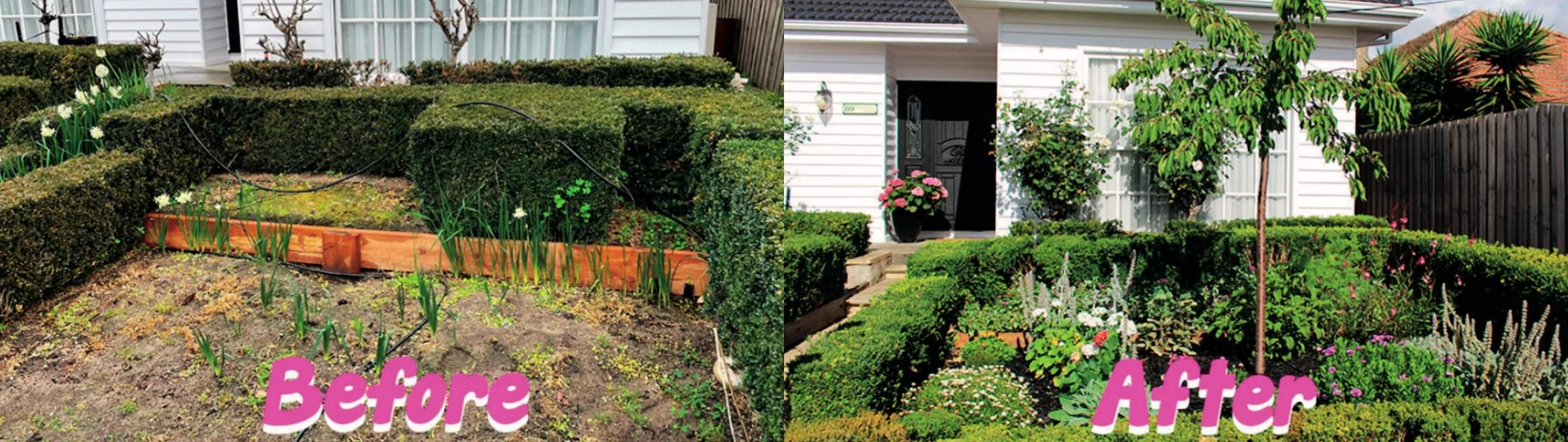
1. Tidy! Take a good look at the garden and remove anything that looks ugly and unfashionable. Some plants are probably overgrown and need a good trim to tidy them up. Let some sunshine and fresh air flow through. Give existing plants some fertilizer to make them nice and lush.
2. Lawn. If you have a sad-looking lawn, fix it! There should be no dead patches. Put down topsoil and grass seed, water it regularly and it will be looking great in no time.
3. Ask the experts. Send us an email at sales@hellohelloplants.com.au with your photos and measurements of your yard. We have a wealth of knowledge about garden design and we can tailor a plan to make your garden pop.
4. Start Planting. Plant your big and cheap plants now for an impressive garden later. Doing this simple process can make all the difference.
• Trees- Keep in mind that some trees grow quite big. Some are maintenance-free, while others do need some care. Be careful NOT to plant big trees close to structures, pipes, and pools as they might cause damage further down the line. If you are unsure about what trees to plant, reach out to us and we will advise you.
• Instant look- If you want the instant look, be sure to pick out bigger pot sizes with established plants. If you are unsure if they are suitable, give us a call or send us an email.
There are some tips to consider:
• Privacy – We all want to feel cozy in our backyard, but that is not possible if we have that nosy neighbor always peeking over for a chat. Some tall Lilly Pillies like Neighbours-be-Gone or a Silver Sheen Pittosporum hedge should quickly fix that problem.
• Lawn edging- A neat lawn that looks restrained and tamed, gives the appearance of being easier to maintain and is a popular selling point.
• Mulch and Weed – Keep those beds tidy and mulched with some black, red, or natural mulch, whichever creates the best harmony with the rest of the garden and the house.
• Repetition- Instead of having too many varieties of plants, consider planting a lot of the same plants in clusters for more dramatic effect.
• Colourful Flowers – These make the garden pop with life and are too easy to plant!
• Maples – Japanese maples are one of the most popular plants to give a wow factor.
• Topiaries – Standard plants and Topiaries look fantastic and have a great appeal. look.
• Privacy screens – Here are some of the best fast growing screens for privacy:
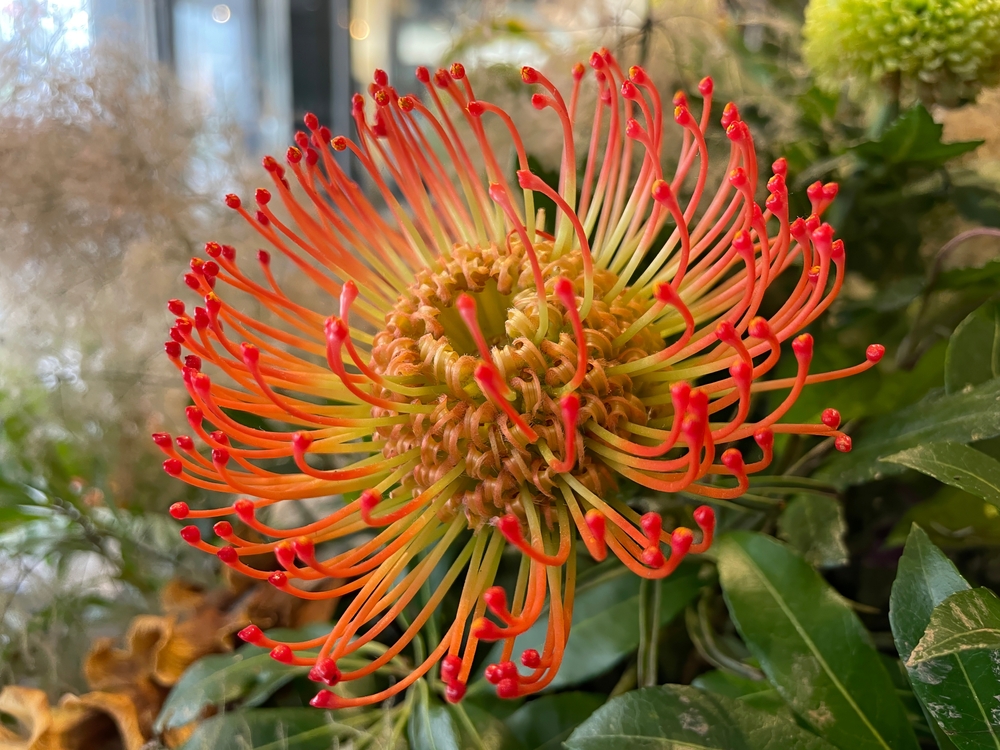
• Natives – Native plants have a high appeal and beneficial to the local fauna. Bird attracting plants are great, bringing beautiful birds to the garden.
• Tropical corners – We all love little cosy tropical corners, and those are easy to achieve with giant birds of paradise, palms, and cordylines for colour.
• Rockeries – If you have an unruly little rock corner, you can easily pop in some tough succulents that will suppress weeds and give great color.
• Grasses – Grasses are great for borders, accents, or focal points.
• Box – Perfect for edging, they give shape and structure to gardens.
• Groundcovers – Ideal to suppress weeds and cover some unsightly places.
• Climbers – Some climbers can go up on fences or structures and look fabulous.
• Trees – Some trees have such a striking look that they can transform any garden.
• Indoor Plants – These bring indoor spaces to life and make a house feel like a home.
That is all for the plant suggestions. All the best in transforming your yard. It is definitely a very rewarding effort!
Hello, hello. This article is all about the right way to water your garden in summer. Now I think this is a very interesting thing because in my experience people generally underestimate what’s involved in watering.
Most people think that watering plants is just a matter of pointing a hose at something or just tipping a bucket of water over your plants or doing this or doing that. But I’ve been watering plants since I was 7 years old. I started out in my dad’s nursery. Dad would get me out there watering his plants and quite a few of them wilted or died or something like that if I missed them. And that got me into serious trouble. So I learnt how to water properly or face the consequences. So basically, I’ve got nearly 60 years of watering under my belt and the point is I’ve always had to water to a professional standard because my watering has always had thousands and thousands of dollars worth of plants involved.
Today in our nursery we have to keep about 200,000 plants in stock and they all have to be watered and they have to be watered correctly. So I’m sure you can understand that I am very much about making sure that I water properly and making sure that my staff water properly. And there are quite a few tricks of the trade in watering, believe me.
Now, the No.1 thing about watering is having the right equipment. Most people at home have a standard 12mm or ½ inch garden hose. And if they go to their local big green hardware store starting with “B” and they get one of those typical little watering guns, when they stand there on a hot summer’s night watering their garden, they think they are getting a lot of water into the ground. But they’re not really. A set up like this would take over a minute or more to fill a typical 10-litre bucket or watering can.
Now you can’t really see the difference until you swap your regular garden hose for an 18mm or ¾ inch garden hose. And what you’ll discover is that the smaller hose is actually holding the water back and stopping you from getting a good flow. If you put the larger diameter hose on the same tap you will get a massive increase in the flow of water out of the same tap.
So much so that with an 18mm hose, you can fill a 10-litre bucket or watering can in around 10 seconds. That’s more than 6 times faster than a standard half-inch hose.
Now the other mistake people make is using these cheap watering guns on the end of their small hoses. They often have them set to make a fine misting spray so they don’t damage their plants but the problem is that doesn’t give the plant much water at all, especially over a hot summer.
Bottom line is that if your hose nozzle is making a lot of noise then it’s doing so because it’s restricting the flow of water coming out of the tap and not letting much out onto your plants. It’s putting the brakes on the water and holding back the flow, which is NOT what you want in a hot Melbourne summer.
But if you add the right nozzle to your larger 18 mm hose you can get a very gentle spray that still delivers a lot of water. We actually have a fantastic nozzle at our store that we use that was designed over 50 years ago. It was created in the US by someone who wanted a very gentle spray that would mimic rain but deliver a huge volume of water. And this head does that. (You can buy them online on our website here but they ONLY fit to the larger 18mm or 3/4″ inch hose.) The other thing that’s great about these nozzles or rosettes is they are very quiet. Those cheap plastic guns make a lot of noise when the spray of water comes out but these aluminium nozzles have this soft spray that comes out so quietly.
It’s also a great time saver as it delivers so much water very quickly without damaging your plants or disturbing the soil.
Another point about your standard garden hose is, have you ever tried to drink the water out of the hose? If you have you might find it tastes funny. That’s because the plastic they make the hose out of is not very good quality and there are various toxins in that plastic that leach out into the water making it taste bad. In complete contrast, the ¾ inch hoses we sell at our nursery are made from a food grade material so if you drink the water out of the hose it takes pure and clean. Also these hoses don’t bend and kink like the cheap thinner ones and they don’t go hard and crack in the hot Aussie sun. This means they not only deliver much more water to your garden, it’s better quality water too.
So you can see just by changing your hose and the watering head you attach to it, can make your watering up to 6 times more effective. Maybe it’s time for you to put your old hose and watering gun in the recycling bin! That would be a good start for you to become a master waterer.
Now the next thing to think about with watering is your mindset. Personally I don’t see watering as just standing there with a hose. But many people do, they think they’re just doing something effective to wet the plants and stop them from dying. But in our nursery we’re not just watering our plants to keep them alive. It’s more than that. We’re actually watering them because they enjoy it. That’s right, they ENJOY it.
Now many plants love the hot summer, they love the hot sun. But they need adequate water to grow and flourish. And just like we enjoy a nice cool drink after a long hot day, so do our plants. So don’t just think about “Hey I don’t want my plants to die”. Think like this, “I really want my plants to flourish!” “I want my plants to grow beautifully.” “I want my plants to thrive”. So it’s a positive thing you are doing for them and giving them when you water them and that’s why you need the right equipment.
Another important point when it comes to watering is to not forget about the edges. If you have square shaped garden beds or anything with corners or spaces away from the plants, then make sure you water the edges of the garden bed and the backs and the corners too. If you do, the middle tends to take care of itself. But many people just water around the base of plants rather than the whole garden bed, so don’t forget to water the edges and the corners too. Plants draw moisture from a wider area than you probably imagine.
Now the next most important thing to tell you about in your search to become a master waterer is soil wetter. So what is a soil wetter and how does it work? Well soil wetters break down the surface tension of the soil to the water so that the water moves quickly and easily through the soil.
So what is the very best soil wetter? Well in my opinion, it’s actually water!!! What do I mean? Well it’s like this. Say you’ve been away for the weekend and you come back and all your pots are bone dry and the plants are just looking very parched and thirsty, if you just go and pound them with water, you’d be amazed. If pulled that plant out of the pot 10 or 15 minutes later, you’d realise there’s just a little bit of water on the top of the soil.
If your plants are bone dry, the best way to water them is to water them two or three times, like this. So you come home, you look at your plants and think, wow, they’re really, really dry. Well give them a fairly quick little water and then you leave them. Go off and have a cup of tea or whatever, then come back in half an hour and give ’em another water. Then, if they’re really, really dry, you might give them a third water.
As an example, we’ve got a lot of succulents growing in our backyard and we didn’t water them for a couple of weeks as I was away. When I got back I went out there and I found that to get the water to the bottom of the pot actually took three waterings. The first watering was fairly quick, the second watering went a little bit longer and that started to get the water halfway down the pot, but to get the water to the bottom of the pot actually took three waterings. So depending on how dry you plants are the secret is that water is fantastic at getting water into the ground.
It’s a funny thing. I used to have a nursery in the middle of Emerald and when the fields were really dry in summer, if we had some summer rain, I’d race out there, put the pump on and put all my sprinklers on to water the plants. People would actually ring me up and say, “Hey Chris, it’s raining and did you know your sprinklers are on?” They thought I was crazy. But in actual fact, if you want to get your paddock really, really wet deep down, the best thing to do is water in the rain.
It’s the same thing in the garden. If your garden’s pretty dry and it’s dry down deep, you’ve got a bit of summer rain, get out there and water in the rain. People will think you are crazy but your plants will love it because it’s like they are getting a double-soak and remember nothing wets the soil better than water!
Now even I can have some challenges when it comes to watering. Recently I had a situation where we had a sort of funny dry spell in late spring, early summer. I came home one day and it seemed like all of a sudden my birches had yellow leaves forming there and I could tell that they were really, really stressed. I knew they’d be stressed down deep. I went and had a look and the soil around the bushes was all cracked. So what I did was I gave them two or three waterings and that got the water in and finally gave them the really big soaking they were looking for. It was funny if I’d just gone out there and stood there for ages trying to do one long watering, the water would’ve been running off here and running off there. But because I did a couple of waters I got a lot into the ground.
Probably the most important thing in terms of watering, is making sure that the ground is moist enough that the water can be accepted deep down. So you come home from work after a long hot day and your plants look dry, then give them a quick squirt, go have dinner, then come back and give ’em a big soak. And if they’re really, really dry, do it a third time.
Now apart from not watering enough, the big question everyone has is, how do you know if you are watering too much? Well the first thing to be careful of with watering is plants like succulents, you know, cactus and the like. Also your Cordylines and your lavenders don’t want too much water. They need a bit of a break between their waterings.
Now here in our nursery we’ve got hundreds of thousands of plants and in summer we water them all every day. And if there’s a heat wave, we’ll water them twice a day.
The frequency of watering for your plants can be affected by the quality of your potting mix. If you’ve got a good quality potting mix then it will let the water in, let it go through and then let it out. But a poor quality potting mix initially repels water. But if you keep watering and the water finally gets into it, it’ll get too wet and stay wet. That’s because in these cheap potting mixes to try and make a profit from selling them so low, they have to add cheap fillers into the mix like sawdust for example. Once it gets wet it just holds the water. It can also contain chicken manure that can burn the roots of some plants.
Your guide to potting mix really comes down to price. If you’re seeing bags of potting mix on sale for $3, they are not worth buying because they will be full of cheap fillers.
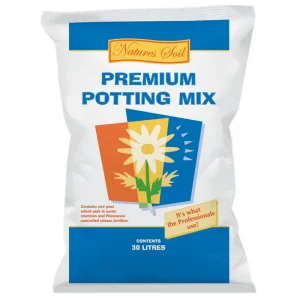
But a good quality potting mix, like the Nature’s Soil that we use in our nursery is a commercial quality mix that is being made for professional nurserymen like me. And we are much more demanding than our customers when it comes to potting mix. It has to be really good because we use it to pot our plants and we would stop buying it straight away if they started putting cheap ingredients in it. (You can buy it from our store.)
So if you’re using good quality potting mix and unless it’s a succulent or a cactus, basically you can water every day through summer and the water will go in flow through and go away. So basically it’s impossible to water too much with plants in pots if you’ve got a good potting mix.
Where it is possible to water too much is with plants in your garden. Now we often have problems where people come in and buy, say a Weeping Cherry or a Weeping Maple. And what happens is that they put their Weeping Cherry in or their Weeping Maple and then they’ll put down turf around it. And the turf people tell them to water their turf 6 times a day. And so what they’ll do is they water the turf for 20 minutes, 6 times a day! In a week or say 10 days later, the Weeping Cherry or Weeping Maple is dead.
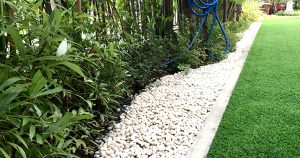
Now that is definitely a case of watering too much because basically you don’t need to water turf that much. If it is hot weather and you’re planting turf and you’ve got other plants you’ve just planted around it as well, you only need to water the turf once really thoroughly. Then after that you just spray the turf for a minute or 30 seconds just to keep the grass wet. You might water it 6 or 8 times a day, but you just spray it lightly so the grass is kept cool and moist and happy. You DON’T give it a deep soaking 6 times a day!
Generally speaking, in the garden you would give plants in the warm weather a good soak once a week. If it was particularly hot, you’d give them a soak two or three times a week and you’re really not going to get into trouble in the garden that way.
Okay, so say you’ve got a section of your garden that’s terribly dry or it’s dried right out and you don’t know what to do. Well this is where you would use an soil wetting agent. There are a number of them around and they are all similar. (We sell one called SaturAid.) Now these are great but I wouldn’t use them unless you have a specific problem to solve, because they are a sort of agricultural detergent and that’s not necessarily kind to the environment. But when you have a real reason to use them, they can do a good job.
So say you have a situation like I did a while ago with a hedge out the back of my place. It had dried right out underneath and was starting to drop leaves and look a bit crook. So what I did was get out the old soaker hose, those ones with the small holes that put out little sprinkling jets of water. I put on about twice the recommended dose of the soil wetter around the base of the hedge and then ran the soaker hose for 30 minutes at a time, every few hours. That combination worked brilliantly because the soaker hose doesn’t flood the place and the soil wetter in combination helped the water get right down deep into the roots. So that’s one example of where I might use a soil wetting product.
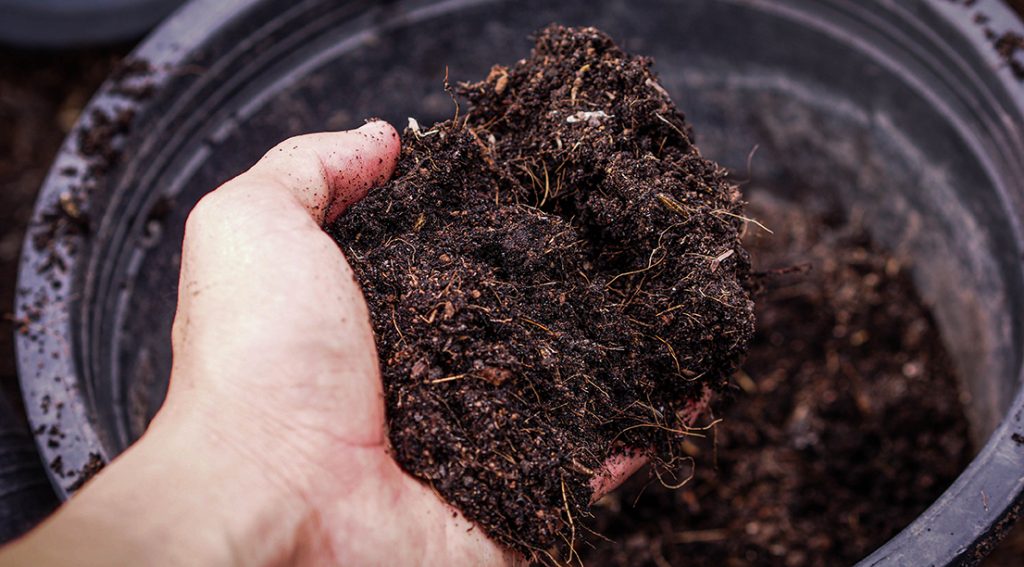
Another situation I would use an actual soil wetting product is when planting, especially if you are planting in summer. Now when they are planting, a lot of people will dig the hole, put in the potting mix with the plant and then maybe top it up with mulch or topsoil or something. So you might have 3 different types of soil mixture that this plant and its root system is sitting in. And they will have different rates at which they will absorb or let water flow through them. So what I would recommend is with summer planting is to put some soil wetting agent in the bottom of the hole and then some on the top when you have finished planting. Give it a really good soak and the soil wetter will help draw the water through all the different layers of soil and help disperse it into the ground beneath the plant.
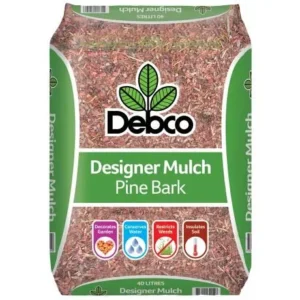
Now what about mulching some people say. Well mulching doesn’t add moisture to the soil by itself. It is for helping keep the moisture you put in the ground stay there. So if you’ve got a problem with some part of your garden drying out, then mulch is not the answer.
Once you’ve got the water into the ground nice and deep then you might go for some mulch to try and keep it in there. You’ll find once you get some water down deep, it’s not hard to keep it moist. But when it’s really, really dried right out, getting it wet again can be quite difficult. But if you apply my approach of multiple waterings in a row, with a good big soak at the end, then you can solve this problem without mulch.
Another problem people have with watering plants in summer is that’s when we tend to go away on holidays and we might have to get a friend or neighbour to water our garden and plants for us. (Maybe show them this article before you put them in charge of the watering!!!) But basically, you can do a lot of things to help your plants cope with the heat while you are away. If you have any of the more delicate plants that don’t like the heat and sun too much, then move them into shade, under the carport or even in the garage where they will be out of the direct hot sun. And if you sit them in trays or anything that can hold some water that they draw back up again this will also help them cope with the heat. You can get a range of large plastic trays or saucers at our nursery to put under your pots and they can hold quite a bit of water to keep the soil in the pot damp for longer. They come in sizes up to 63 cm. Without a saucer under them, many pot plants might only last a few days without water but with the saucer they can last up to a week.
So there you have it, all the ins and outs of watering from someone who learnt the hard way as a child how to water properly. The biggest problem with watering is to think there is nothing to it and it’s just simple and holding a hose. But I hope from reading this article that you now realise you’ve got to know what equipment to use. You’ve got to know when to water and how to water. You’ve got to know what to do when it rains and when it doesn’t.
Remember too your mindset if you’re a keen gardener, you’re not there to just keep your plants alive. You’re there to have them flourish. Keeping your plants alive is one thing. Having them flourish is a whole different ballgame. And flourish means that the plant has adequate water right to the bottom of the pot or the plant in the garden down deep where its roots are, so it has plenty of water to draw on. And if you do that, you’ll have a really beautiful garden.
Let me tell you a story to finish this article off which I think illustrates the point I’ve been trying to make. I had a customer once who was actually a weatherman on one of the TV stations and he bought a whole lot of Mop Tops from me. Soon after he rang me up and said, “look, I’ve bought a lot of Mop Tops off you and they’ve got a disease or something. They’re all just turning brown and dying. I need you to have a look at them.”
So I went over to see him and he had this beautiful lush green lawn, absolutely fabulous green cooch lawn. Fantastic. And then he had these Mop Tops everywhere in the garden. It was a very modern house with Mop Tops and green lawn. And there they were. There was a dead one here and a dead one there. And he’d been replacing a few too. So I started scraping some of the dirt away at the base of one of the Mop Tops and I dug down a bit and there was dust. So I dug a bit further and it was just dust, dust, dust, dust, dust down deep. I said to him, you need to water them. He said, I do. He said, I water them every day. I said, how long for? He said for 30 seconds!
What he was doing was he was keeping the grass really lush and beautiful with 30 seconds of water every day. His lawns were fantastic, but his Mop Tops had not enough water. He wasn’t watering them. He was actually teasing them with just a little bit of water every day that never really soaked into the ground and just probably evaporated of the top of the soil, leaving dust below. So I said to him, just water your Mop Tops for 1 hour every week. Give them a huge soaking once a week. I never heard from him again so I assume that worked for it, as it would have! So giving your garden a big long soak is better than small regular waterings.
Happy watering!!
Feeling inspired to create your own garden, but want some expert advice? Try our one-on-one garden design service with Chris. Together you’ll come up with a selection of plants along with a layout plan that gives you the look you want, as well as being suitable for your local soil and conditions.
Smooth, sleek and contemporary is a top contender for the most coveted gardens style in Chris’ Free Garden Design service. This style can be adapted to any size garden, environmental conditions and can incorporate other garden styles in the design! We’re talking modern tropical, modern coastal or even modern cottage! But what elements actually make a modern or contemporary garden? This can be the part that makes designing your own modern garden tricky. So below we’ll go over some of the design elements Chris goes through in his contemporary garden designs.
If you need more advice on how to create a modern garden, we can assist you with tips, tricks or even a full tailormade garden design with Chris. Book one here!
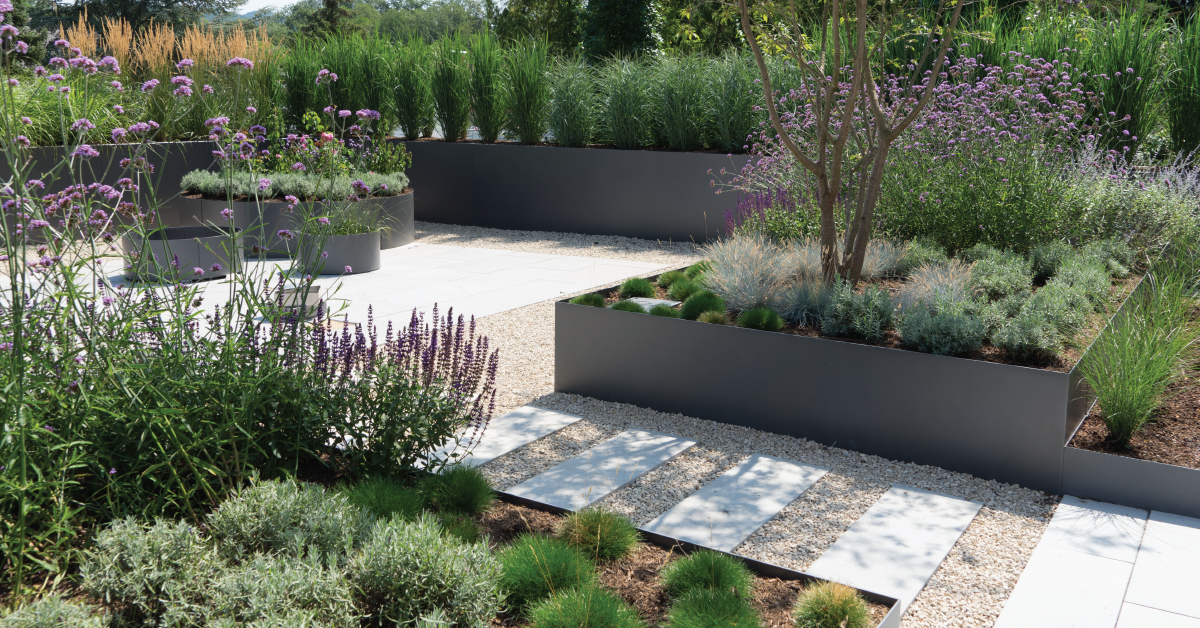
Simplicity is key in a contemporary garden design. You don’t want to over crowd or clutter the garden, creating too much busy-ness. Modern gardens tend to have simple easy repetitive lines and shapes such as square, raised garden beds, all the same colour and texture and shape, the only variance being their height or length. Soft, rounded edges can also be used but it is paramount they are even, smooth and almost blend in with the surrounds.
Geometric shapes and lines don’t work unless they are balanced with the surrounding spaces. Geometry is precision work and is what makes the garden as a whole pleasing to the human eye. We can often tell when the lines of a garden bed or wall are incorrect and it’s so distracting! This also applies to the placement of objects and shapes in a design. It can be too colour heavy on one side of the design or not enough of a certain texture, which makes the whole feel of the are feel weird. This is when balance is usually off!
An element of the modern garden that isn’t considered until suggested by the designer is that of a functional space that joins the inside with the outdoors. This can be in the form of an outdoor living area or outdoor kitchen.
Retaining walls and planters can double as seats with carefully designed indented benches that meld seamlessly into the geometric design. Modern designs will generally have very deliberate and useful design elements, no questionable or confusing sections with unknown functions!
Nothing says modern like soft stone colours, charcoals and very light pastels. The colours of retaining walls, pavers, steps and buildings are often subdued so they don’t distract or detract from the plants of the main feature. This is also applied to the plants used. Green & White is a very common colour scheme for a modern garden as it is subdued and simple, no one plant necessarily stealing the show with a mess of colour. When colour is used, it’s applied en-masse, large drifts or rows of the same colour planted together to great effect. Good examples of this are simple green hedges, large, swathes of green or silver groundcovers, and blocks of lavenders, fescues or salvias.
Along with your simple colours, simple textures must also be used. Generally you won’t want any strongly patterned textures such as red brick or paisley confusing the area. The plants will usually create enough textural contrast and just require a simple backdrop or border to shine against. There’s no need to remove everything that might conflict with this tip! Bricks and tiles can easily be painted over to create a simplicity.
6. Lighting
Outdoor lighting not only brightens your backyard but can highlight a feature, draw your attention to elements of interest or set the mood. There are many outdoor lighting options available but remember to keep it simple so no leadlight lamps or spotlights!
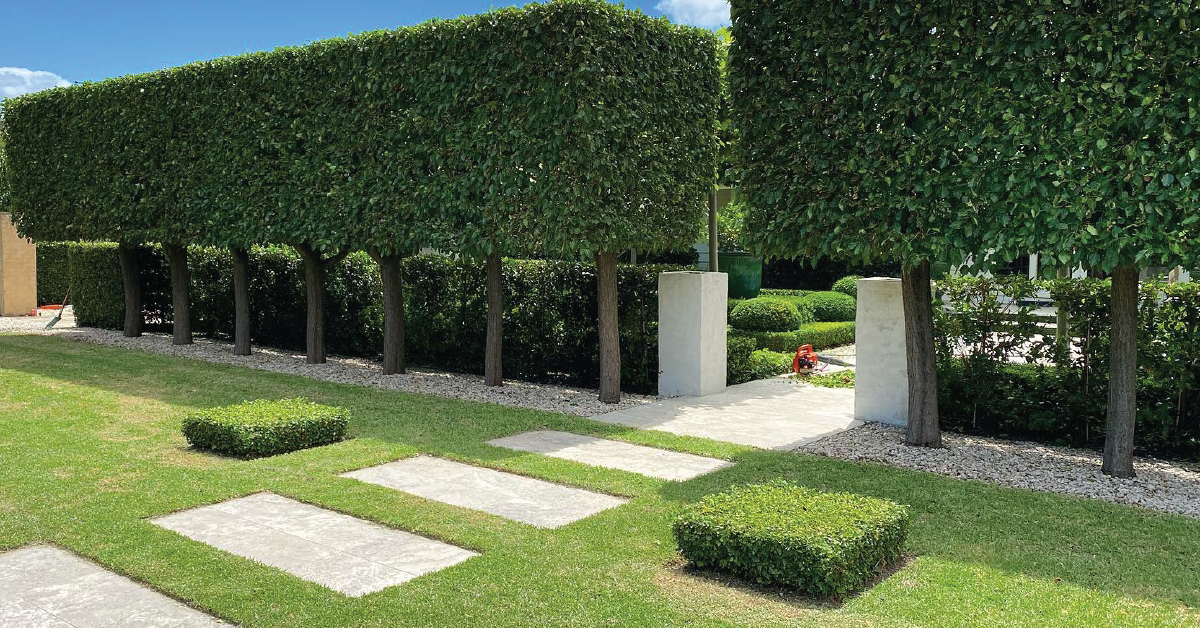
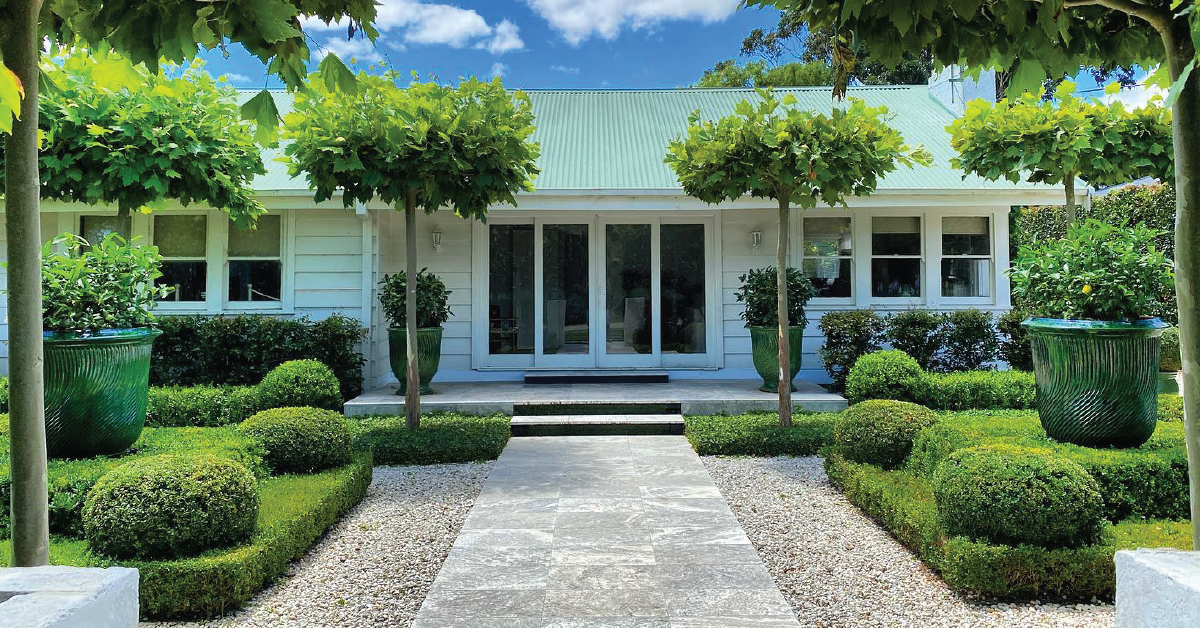
It’s no doubt about it, some plants have really striking foliage and form, becoming almost an architectural feature in themselves. Such plants as Agave, Senecio ‘Blue Chalk Stick’ or Gymea Lily have strong shapely foliage that draws the eye and contrasts against almost any other plant or building. Other, what you might call standard style foliage plants such as the hedging varieties (Buxus ‘English Box’ or Murraya ‘Orange Jessamine’), look almost nondescript by themselves. BUT! When trimmed into a strong box hedge with simple straight lines or perfectly symmetrical topiary balls, it makes them an eye-catching contrasting feature yet not to ‘out there’ for the contemporary garden. And if the geometric lines get too much, soften your edges with a mass planting of Poa ‘Tussock Grass‘ or Myoporum ‘Fine Leaf’ groundcovers.
8. Garden features – sculptures, ornamental pots and water
There is room for some of the standard garden ornaments but once again keep it simplistic, minimal and neat. This isn’t the garden to have a hoard of gnomes scattered about! A single large urn with a Topiary Buxus Ball or trailing Dichondra ‘Silver Falls’ groundcover can make a beautiful, timeless feature and breaks up the landscape. This is also the type of garden where the complementary geometric or fluid shapes of contemporary sculptural art really shine. Artists such as David Harber create works that reflect the environment in which they are placed and truly add a finishing touch to the garden space.
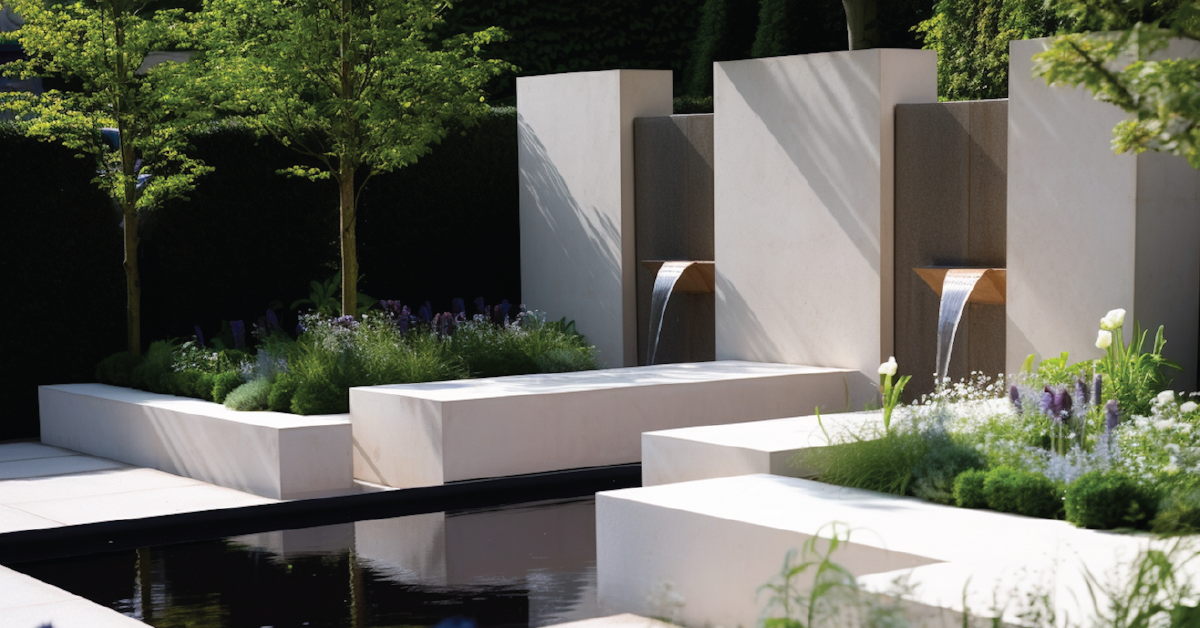
If ornaments and artwork aren’t you thing, then consider the sound, movement and tranquillity that a water feature can add to your garden. Dispel the dated ideas of the cottage fishpond or the Japanese Koi and gravitate toward the the sculptural forms of a spherical water feature or wall of water. Remember to keep your simple and timeless shapes!
Now we know we have said to stay away from strong patterns on your walls, pavements and garden features but patterns are still subtly prevalent in your planting and structural work. We’re not necessarily talking about planting a colourful alternating pattern of vibrant colours. Here we are referring to the repetition of the same colour and shape. Think of the pattern your hedges may create. Two layers of box hedging in a square shape is a simple yet effective pattern. The repetition of the same size and colour pavers as a walkway through a neat lawn is a subtle and well balanced pattern. A continual colour, texture or simple pattern that looks good in all seasons holds the garden together.
We all have the temptation to add a busty Greek goddess or a Tiki Bar into the garden because we’ve seen them in the latest magazines, reality TV show or the neighbours bragging about theirs. But remember – these fads age, badly! The key to the modern garden is to keep it modern! This garden style doesn’t age, instead it maintains its style and grace throughout the decades.
Chris’s Guide to Choosing the Right Ficus for Your Garden
Ficus trees are hardy, versatile and widely used across Australian landscapes. Among the most popular varieties are Ficus Flash, Ficus Hillii, and the increasingly popular Ficus California. Each one offers unique benefits in growth habit, foliage, hardiness, and suitability for different locations. Here’s a simple guide to help you choose the right one for your garden or project
Which Ficus to Choose?
Don’t miss the video below—Chris reveals all the beautiful and unique Ficus varieties!
↓
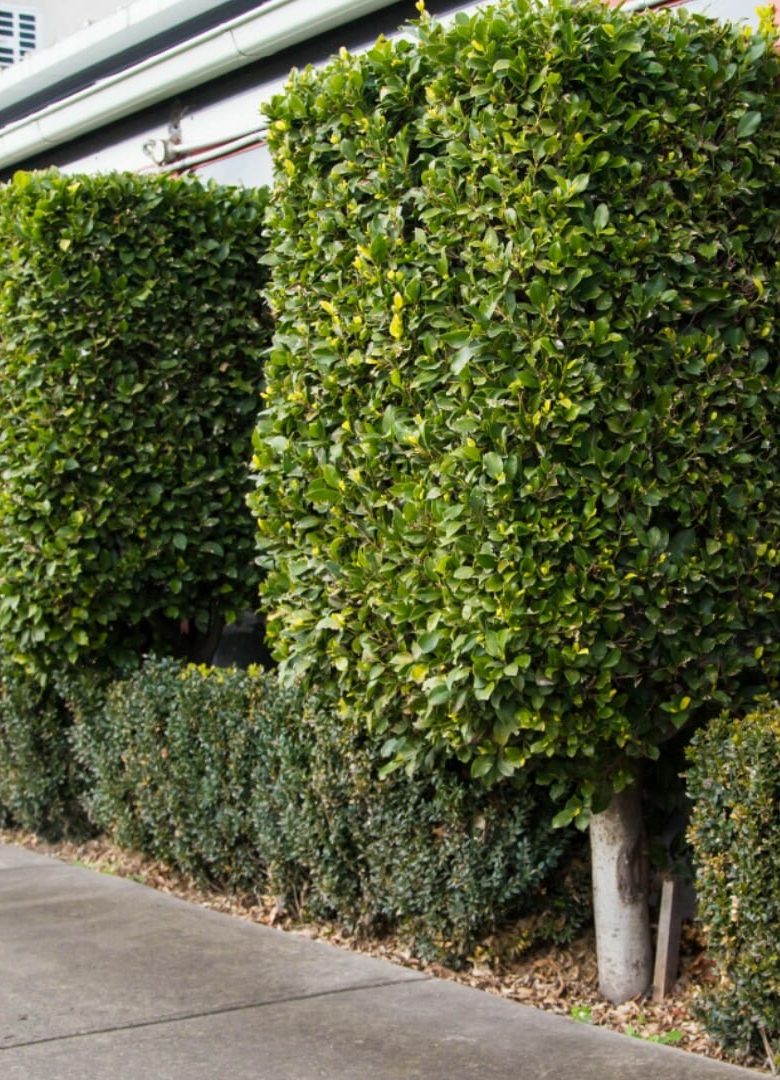
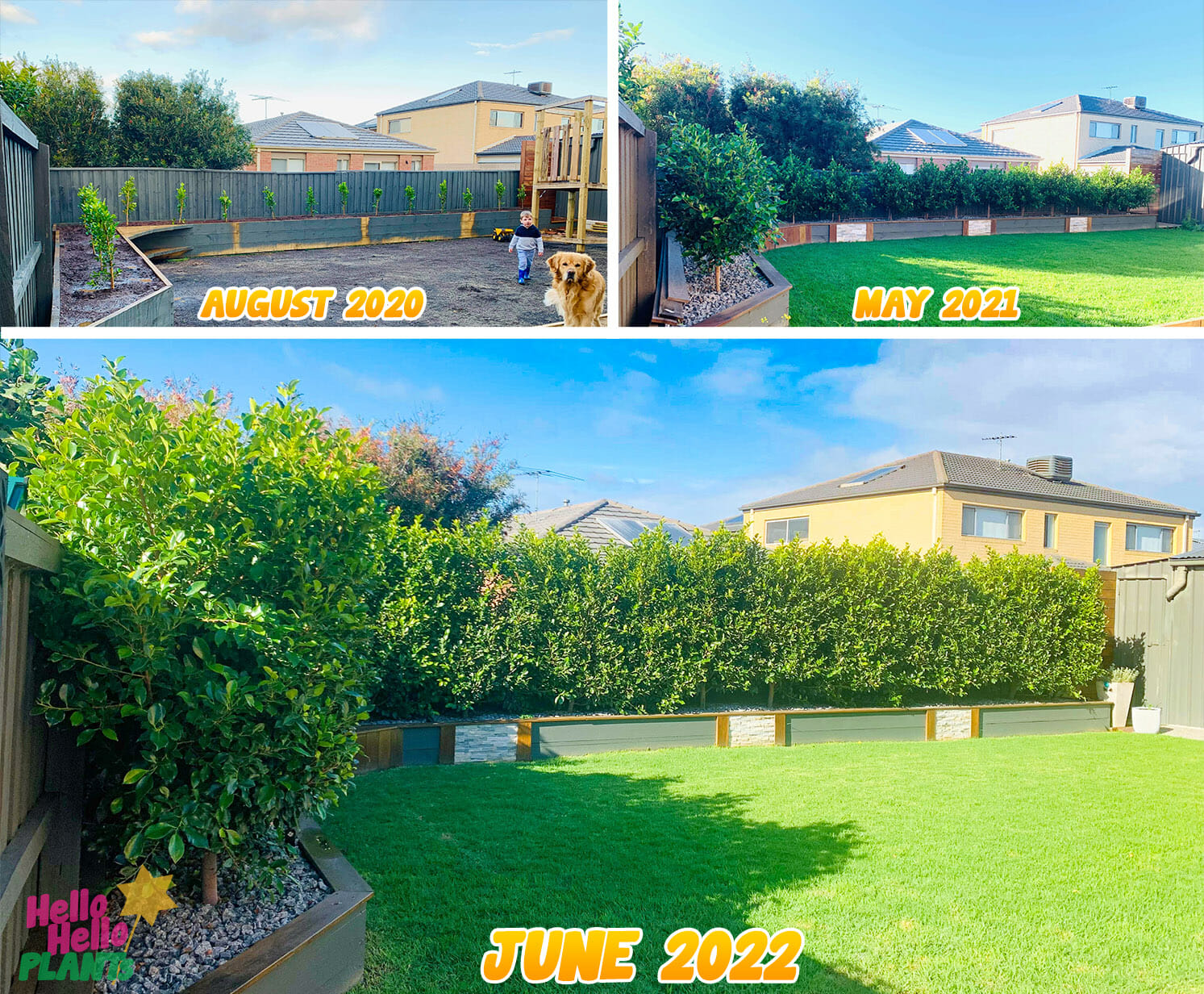
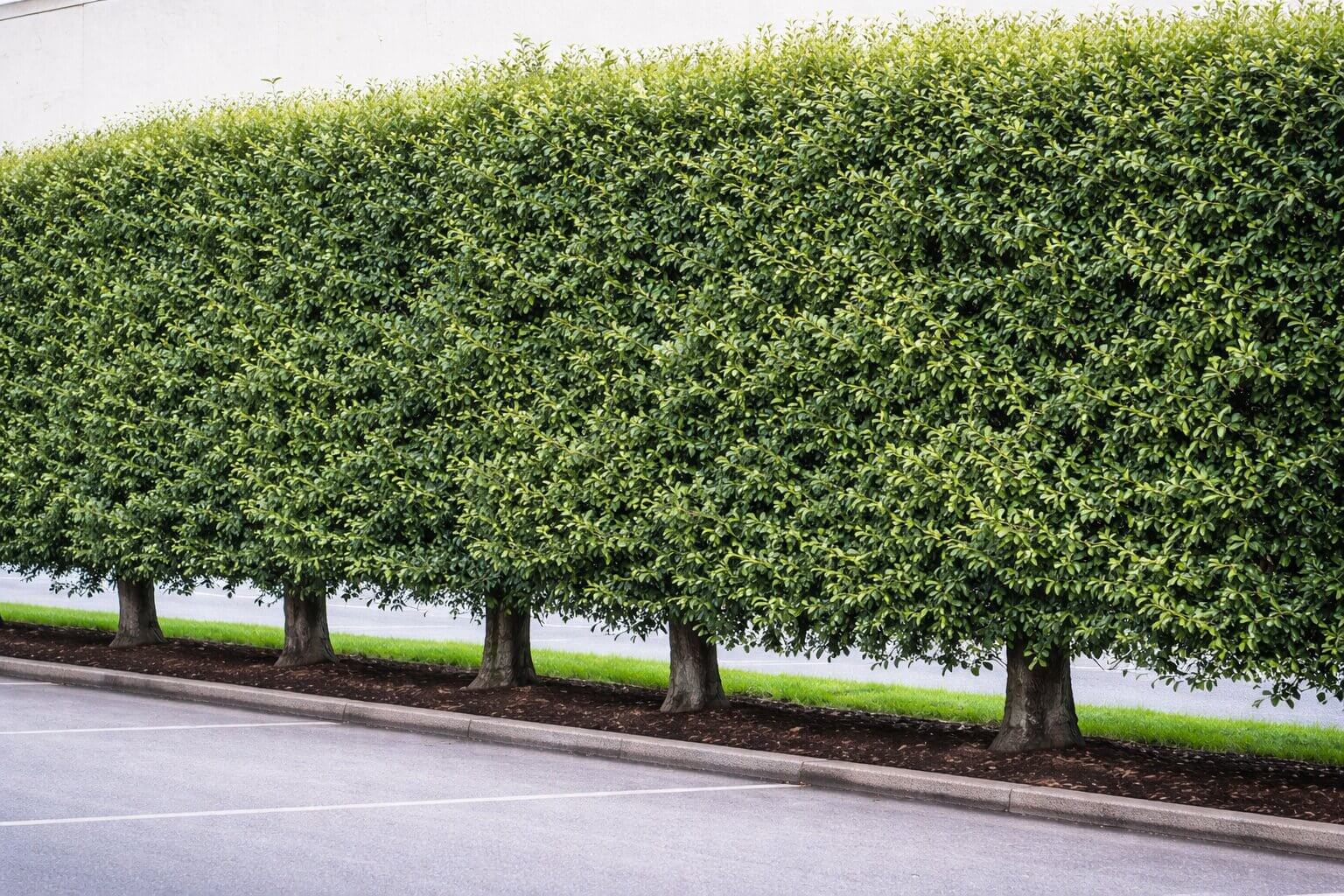
Ficus Flash is known for its slightly curly leaf and its incredible speed of growth — it grows in a flash. Whether you start with a small plant or a large one, this variety fills out fast. Small plants quickly become lush hedges, and advanced plants become impressive screens in very little time. Ficus Flash has a strong, upright growth habit and maintains dense, green foliage year-round. It’s ideal if you want to block out neighbours or eyesores quickly with a vibrant, evergreen hedge. It does have a vigorous root system, so if planting close to structures you’ll need to keep it trimmed and maintained. It’s very hardy, works beautifully in pots, and is excellent for shaping.
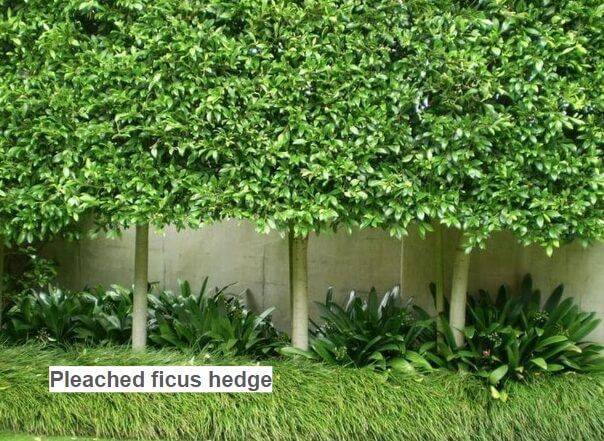
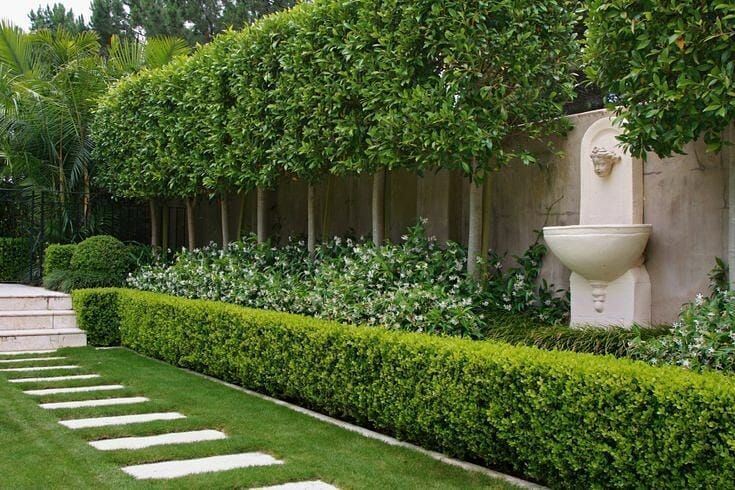
You can grow Ficus Flash in several attractive forms, including as a standard with a clean trunk and round canopy, as a pleached hedge with a tall trunk and a square or rectangular top, or as a classic dense hedge. It thrives in full sun, tolerates short dry spells, and handles heat well. Just avoid heavy shade, as it struggles in darker areas. Overall, Ficus Flash is an extremely reliable, versatile choice for a wide range of garden styles.
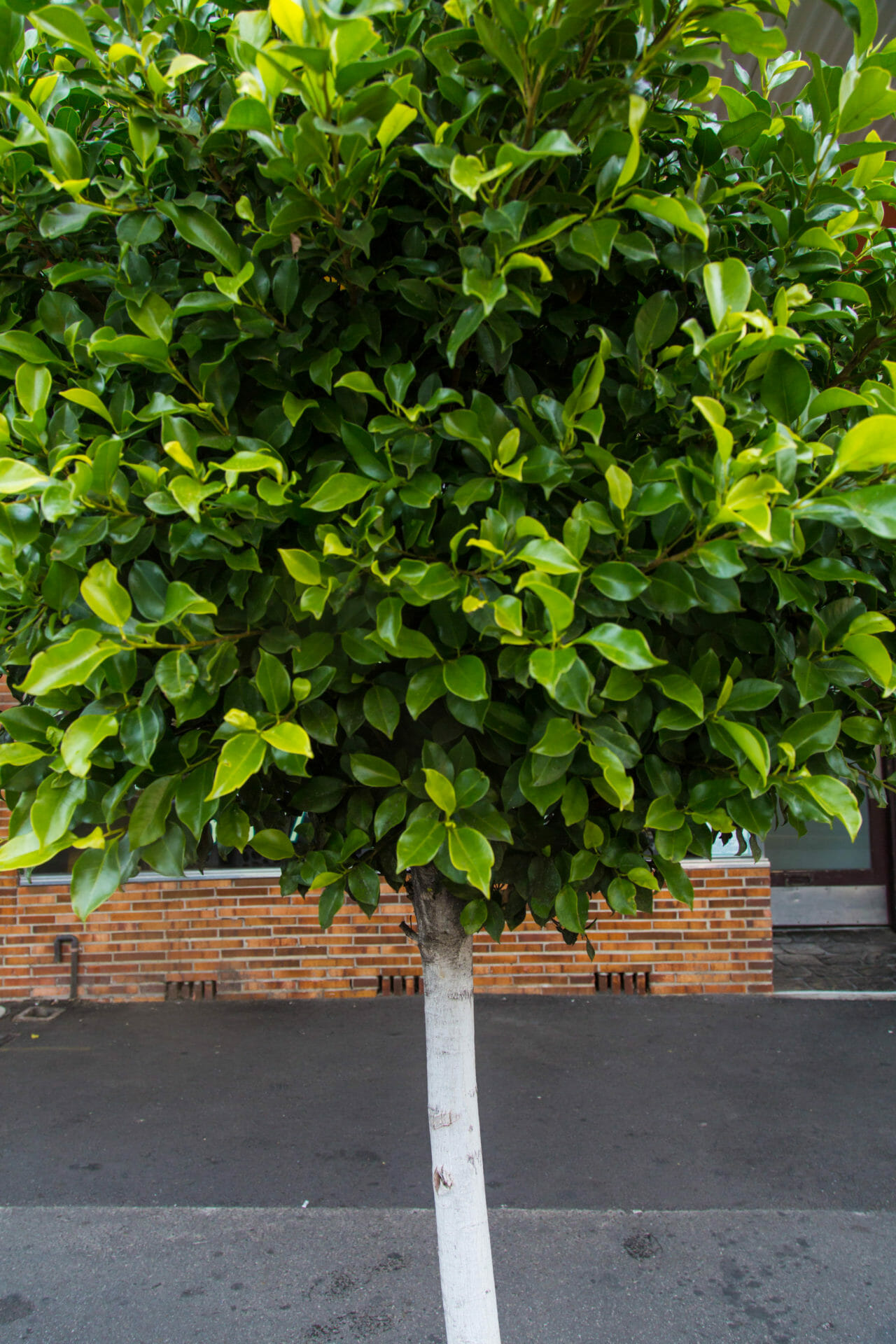
Ficus Hillii is the classic Ficus you often see in older shopping centres and established parks — tall, impressive and elegant. It features fine, dense foliage with a slight weep and longer straighter leaves compared to Ficus Flash. On mature trees you’ll also notice its beautiful
smooth white trunk. Like Ficus Flash, it can be used in a huge range of applications: ● pleached ● in pots ● as a standard ● as a dense hedge or screen
It offers two major advantages:
1. A more refined, classic Ficus look — finer foliage, a slight weep, and distinctive white bark.
2. Superior frost hardiness once established.
Young plants may get a little frost burn, but once settled they tolerate frost far better than Ficus Flash.
If you live in a cold or rural area with regular frosts, Ficus Hillii is the safer choice.
Ficus California is the new favourite — especially in America — and is now becoming popular here for very good reasons. Unlike traditional Ficus varieties that naturally grow into very large trees, Ficus California is much more compact, with smaller roots, making it safer to plant near houses, driveways, and tight garden beds.
It’s ideal for: small spaces, confined root zones, long-term use in pots, and for customers wanting the Ficus look without the large tree size.
Ficus California thrives in coastal areas—unlike Flash and Hillii which only tolerate light salt, it grows right up close to the beach.
It is highly: salt-hardy, heat-hardy, wind-hardy, and drought-hardy.
Its only weakness: not frost-hardy, so avoid cold or inland frosty zones.
It has dense compact foliage, a smaller trunk, and clean white bark—excellent for topiary, standards, pleaching, and architectural shapes。
⚠️ Warning: Be mindful that Ficus can have invasive roots and, if planted near water pipes or pools, may seek out moisture. If root growth is a concern, keep it under control by maintaining hedges and standards at a medium or low height.
Ficus as a Hedge Growth Guide
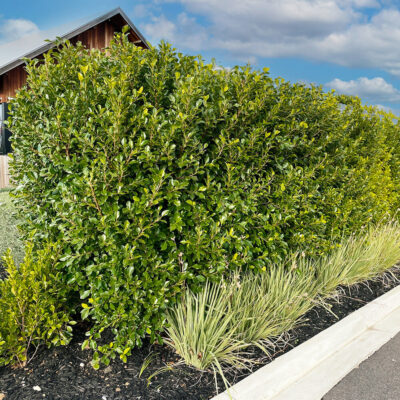
Ficus Hedge growth speed. Photos provided by Nicole.D
Still having trouble deciding which ficus is right for your project? Compare the key features below:
Uses
Tolerances
Trunk
Max. Size
Flash
Standard Topiary Pleaching Tall Hedge Medium Hedge Pots
Full Sun Part Shade Poor Soils Pollution
Brown
10m × 3m
Hillii
Standard Topiary Pleaching Tall Hedge Medium Hedge Pots
Full Sun Part Shade Poor Soils Pollution Frost
Pale Grey / White
10m × 3m
California
Topiary Pleaching Medium Hedge Pots
Full Sun Dappled Shade Poor Soils Pollution
Light Brown
8m × 3m
Emerald
Standard Topiary Pleaching Tall Hedge Medium Hedge Pots
Full Sun Part Shade Poor Soils Pollution
Dark Brown
8m × 3m
Which Ficus Should You Choose?
Use this simple rule of thumb:
🌿 Fastest growth / lush instant hedge: Ficus Flash
❄️ Colder, frosty areas / classic look: Ficus Hillii
🏡 Small spaces / near houses / coastal areas: Ficus California
Browse our varieties and pick the right Ficus for your conditions.
If you’re unsure, call our team on (03) 9359 3331 — we’re always happy to help you choose the perfect plant.
Select the fields to be shown. Others will be hidden. Drag and drop to rearrange the order.












































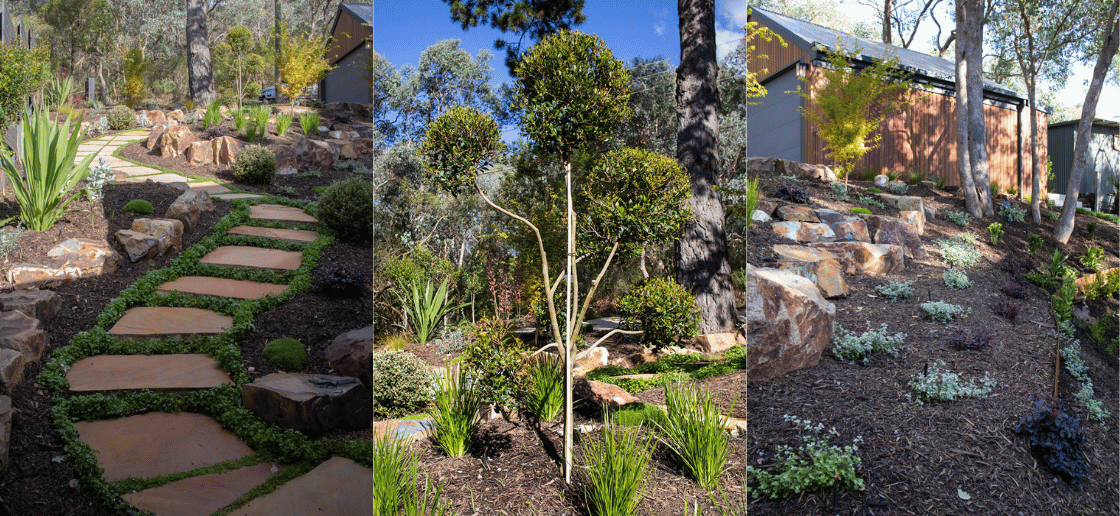

 • Trees- Keep in mind that some trees grow quite big. Some are maintenance-free, while others do need some care. Be careful NOT to plant big trees close to structures, pipes, and pools as they might cause damage further down the line. If you are unsure about what trees to plant, reach out to us and we will advise you.
 • Privacy – We all want to feel cozy in our backyard, but that is not possible if we have that nosy neighbor always peeking over for a chat. Some tall Lilly Pillies like



 Now the other mistake people make is using these cheap watering guns on the end of their small hoses. They often have them set to make a fine misting spray so they don’t damage their plants but the problem is that doesn’t give the plant much water at all, especially over a hot summer.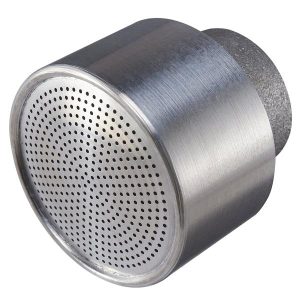
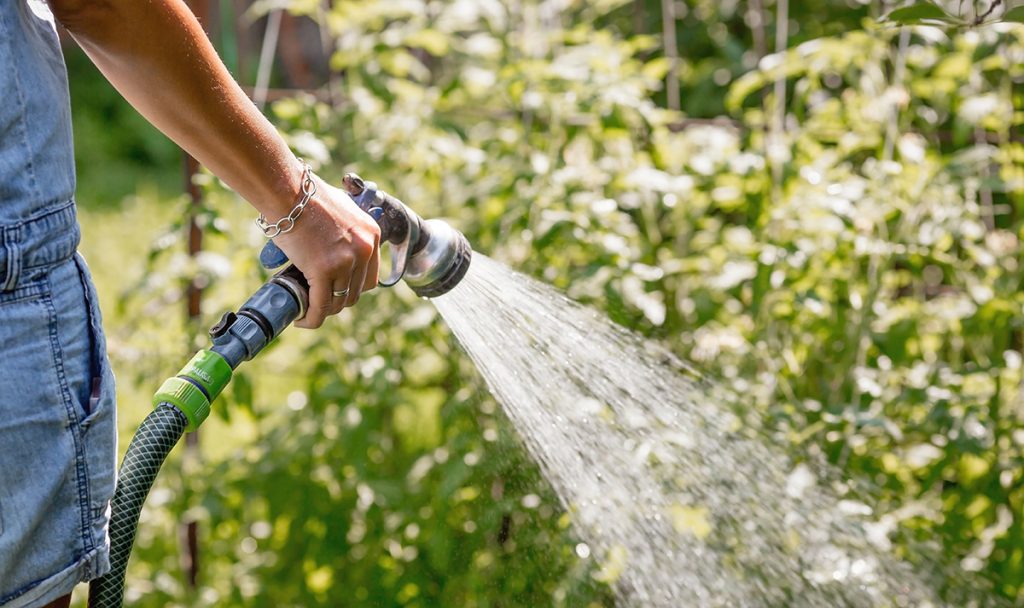
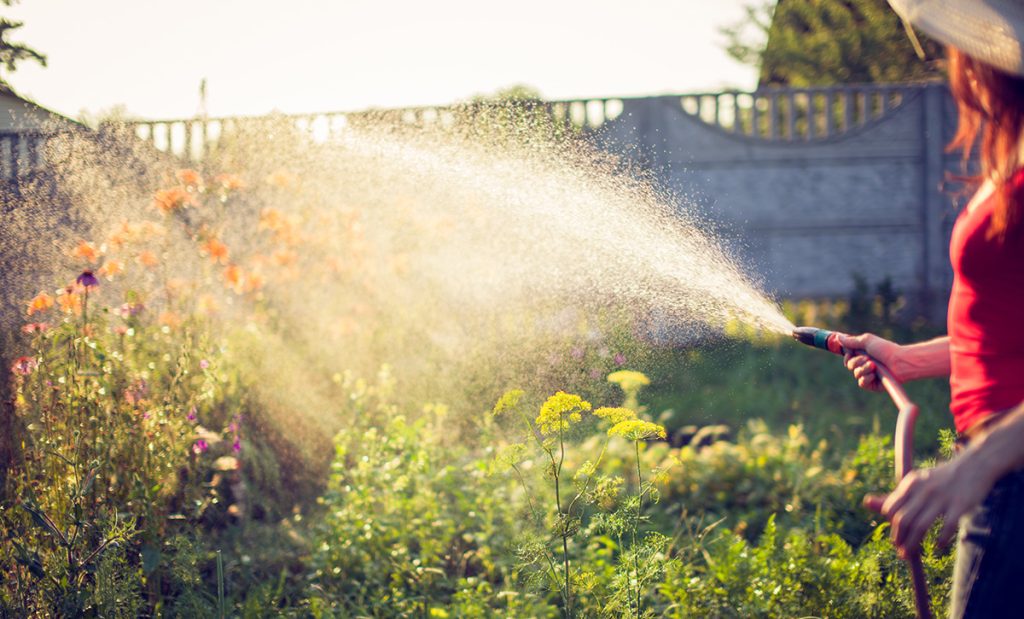
 Now many plants love the hot summer, they love the hot sun. But they need adequate water to grow and flourish. And just like we enjoy a nice cool drink after a long hot day, so do our plants. So don’t just think about “Hey I don’t want my plants to die”. Think like this, “I really want my plants to flourish!” “I want my plants to grow beautifully.” “I want my plants to thrive”. So it’s a positive thing you are doing for them and giving them when you water them and that’s why you need the right equipment.



 Now even I can have some challenges when it comes to watering. Recently I had a situation where we had a sort of funny dry spell in late spring, early summer. I came home one day and it seemed like all of a sudden my birches had yellow leaves forming there and I could tell that they were really, really stressed. I knew they’d be stressed down deep. I went and had a look and the soil around the bushes was all cracked. So what I did was I gave them two or three waterings and that got the water in and finally gave them the really big soaking they were looking for. It was funny if I’d just gone out there and stood there for ages trying to do one long watering, the water would’ve been running off here and running off there. But because I did a couple of waters I got a lot into the ground.



 Now that is definitely a case of watering too much because basically you don’t need to water turf that much. If it is hot weather and you’re planting turf and you’ve got other plants you’ve just planted around it as well, you only need to water the turf once really thoroughly. Then after that you just spray the turf for a minute or 30 seconds just to keep the grass wet. You might water it 6 or 8 times a day, but you just spray it lightly so the grass is kept cool and moist and happy. You DON’T give it a deep soaking 6 times a day!
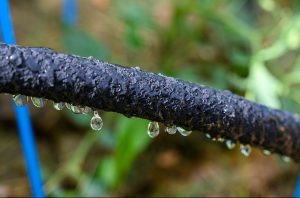 So say you have a situation like I did a while ago with a hedge out the back of my place. It had dried right out underneath and was starting to drop leaves and look a bit crook. So what I did was get out the old soaker hose, those ones with the small holes that put out little sprinkling jets of water. I put on about twice the recommended dose of the soil wetter around the base of the hedge and then ran the soaker hose for 30 minutes at a time, every few hours. That combination worked brilliantly because the soaker hose doesn’t flood the place and the soil wetter in combination helped the water get right down deep into the roots. So that’s one example of where I might use a soil wetting product.
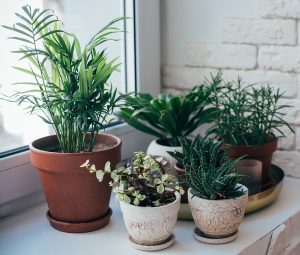 Another problem people have with watering plants in summer is that’s when we tend to go away on holidays and we might have to get a friend or neighbour to water our garden and plants for us. (Maybe show them this article before you put them in charge of the watering!!!) But basically, you can do a lot of things to help your plants cope with the heat while you are away. If you have any of the more delicate plants that don’t like the heat and sun too much, then move them into shade, under the carport or even in the garage where they will be out of the direct hot sun. And if you sit them in trays or anything that can hold some water that they draw back up again this will also help them cope with the heat. You can get a range of large plastic trays or saucers at our nursery to put under your pots and they can hold quite a bit of water to keep the soil in the pot damp for longer. They come in sizes up to 63 cm. Without a saucer under them, many pot plants might only last a few days without water but with the saucer they can last up to a week.
 Remember too your mindset if you’re a keen gardener, you’re not there to just keep your plants alive. You’re there to have them flourish. Keeping your plants alive is one thing. Having them flourish is a whole different ballgame. And flourish means that the plant has adequate water right to the bottom of the pot or the plant in the garden down deep where its roots are, so it has plenty of water to draw on. And if you do that, you’ll have a really beautiful garden.
 So I went over to see him and he had this beautiful lush green lawn, absolutely fabulous green cooch lawn. Fantastic. And then he had these Mop Tops everywhere in the garden. It was a very modern house with Mop Tops and green lawn. And there they were. There was a dead one here and a dead one there. And he’d been replacing a few too. So I started scraping some of the dirt away at the base of one of the Mop Tops and I dug down a bit and there was dust. So I dug a bit further and it was just dust, dust, dust, dust, dust down deep. I said to him, you need to water them. He said, I do. He said, I water them every day. I said, how long for? He said for 30 seconds!