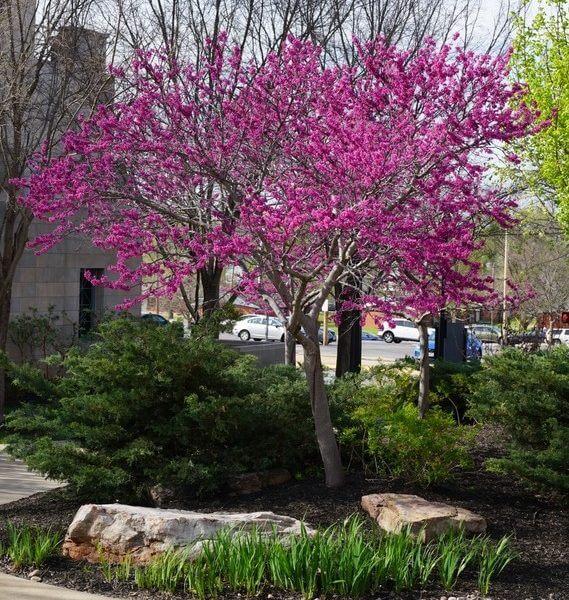
| Description | Cercis canadensis
The Cercis canadensis 'Little Woody,' often referred to as the Canadian Redbud, is the smallest variety of its kind. It reaches a height and spread of up to 2 meters, making it a fantastic choice for adding greenery to compact spaces like small gardens, terraces, or balconies. Its distinctive flared shape adds charm to any landscape. In the spring, this plant truly comes alive with an abundance of small pink-violet flowers that bloom in clusters along the bare branches and trunk. Developed through American breeding, the 'Little Woody' is exceptionally resilient, able to tolerate a range of temperatures.
For care instructions and additional information, click here!
| Acer palmatum, Sango-kaku, Coral Bark Maple
You simply can’t miss the Senkaki Maple with it’s distinctive coral-red bark, which contrasts with its bright green leaves in Spring and Summer. Autumn sees the foliage turn gold and eventually Winter leaves you with a beautiful bare sculpture of a tree with striking red bark. One of the beauty queens of all deciduous trees.
Forms a beautiful vase shaped tree.
Grows Approximately H: 5 Meters W: 4 Meters | Lagerstroemia indica x L. fauriei 'Tonto' Crepe myrtle
Tonto Crepe Myrtles are tough, small trees that offer attractive bark, masses of red to dark pink flowers in summer and good yellow-orange autumn colours. One of the most popular hardy small trees around.
Crepe Myrtles are adaptable to most conditions, suitable for small gardens or amenity areas and can be a very effective street tree.
16" pot size. |
| Content | | The Japanese Senkaki Maple is the only maple tree which provides beautiful vibrant colour all year round, with it’s bright coloured bark that really stands out in winter. This is why it is commonly known as Coral Bark Maple.
The Senkaki Maple is a beautiful small tree and is one of the best examples of a Japanese maple, providing your garden with a lovely small feature tree as a centre piece. It grows approximately 4-5m wide and high.
Light green foliage appears in spring then turns to classic autumn tones. As the leaves start to fall the stems of the trees turn to a “fire engine red” colour for winter. This superb tree makes a wonderful feature in any sheltered spot in the garden. | |
| Additional information |
| Sunshine |
Full Sun, Part Shade
|
| Botanical Name |
Cercis canadensis 'Eastern Redbud'
|
| Origin |
USA
|
| Plant Type |
Tree
|
| Leaf Drop |
Deciduous
|
| Tolerances |
Soggy Soil Sensitive, Frost Tolerant
|
| Water Requirement |
Moderate
|
| Soil Type |
Loam, Loamy – Clay, Sandy – Loam, Well drained
|
| Fertilise Me |
April, March, November, October, September
|
| Fertilizer Frequency |
Bi-annually
|
| Planting Distance |
2-3m apart
|
| Max Height |
10m
|
| Max Width |
8m
|
| Growth Speed |
Moderate
|
| Prune Me |
Only if required, Only in winter
|
| Flower Colour |
Bright Pink, Purple
|
| Flowering |
Yes
|
| Flowering Time |
October, September
|
| Foliage Colour |
Purple
|
| Autumn Colour |
Yellow
|
| Attracts |
Birds, Butterflies
|
| Best time to plant |
All Year
|
| Fruit / Seed |
Rarely, Yes – Non-edible
|
| Uses |
Feature, Shade Tree, Mass planting
|
| Toxic To |
Non-toxic
|
|
| Botanical Name |
Acer palmatum 'Senkaki'
|
|
|